Art Club for All & ART RETREAT Info Session
Thank you to everyone who joined us to create together, and to those of you who will soon catch the replay below! Connecting and creating with you is truly my favorite part of the day.
If you're interested in joining this year’s ART RETREAT, I’d love to hear from you! Please don’t hesitate to reach out with any questions you might have.
The retreat is called the Alchemical Ritual of Trust, to tend to the artist and support us in exploring ourselves and trusting our creative cells while in community!
There’s something profoundly enriching about gathering with the intention of reconnecting with our innate creative wisdom.
All are welcome, as long as there is a part of you curious or ever curious about creativity, the creative process, or remembering that part of you in a new way!
Alchemical Ritual of Trust
DATES: October 14-19, 2026
PLACE: Rancho Gallina Eco Retreat, Santa Fe New Mexico
INVESTMENT: 2300 USD (single occupancy with shared or private bath)
Four-month payment plan is availible (4 payments of $575)
RESERVE YOUR SPOT IN ART RETREAT
Retreat Includes:
Accommodations at Rancho Gallina Eco
Meals (Breakfast, Lunch, Dinner)
All creative workshops
Tea Ceremony
Creative supplies
One entry to O'Keeffe Museum or a local museum
Does not include:
Airfare, transportation within New Mexico, meals in town, or tips.
Suggested supplies:
📖 2-3 sheets of paper
✏️ Colored pencils, crayons, markers, watercolor, and pastels
💭 Your imagination
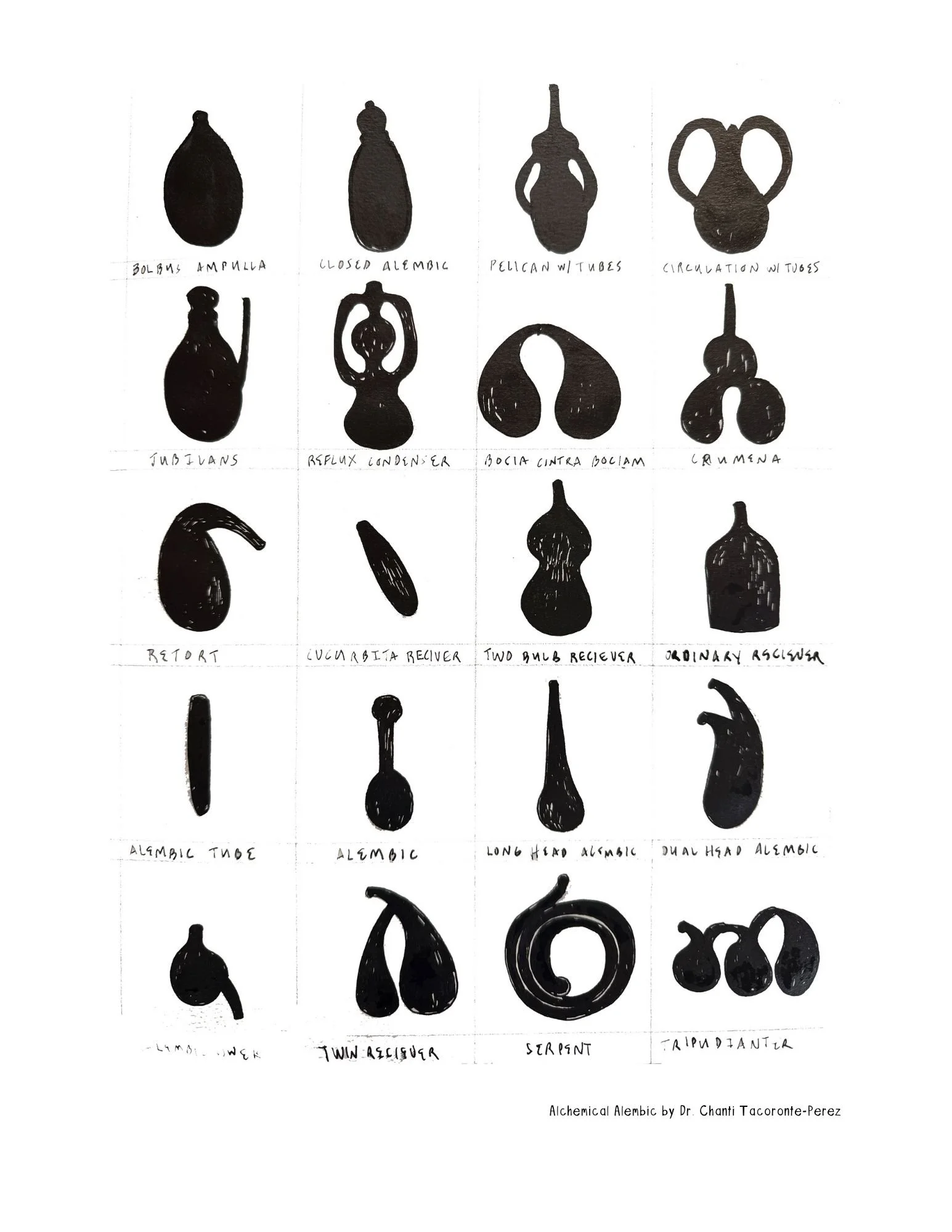
The Alchemical Alembics (see below)
Bounus Day: Yoga Nidra—Effortless Ease
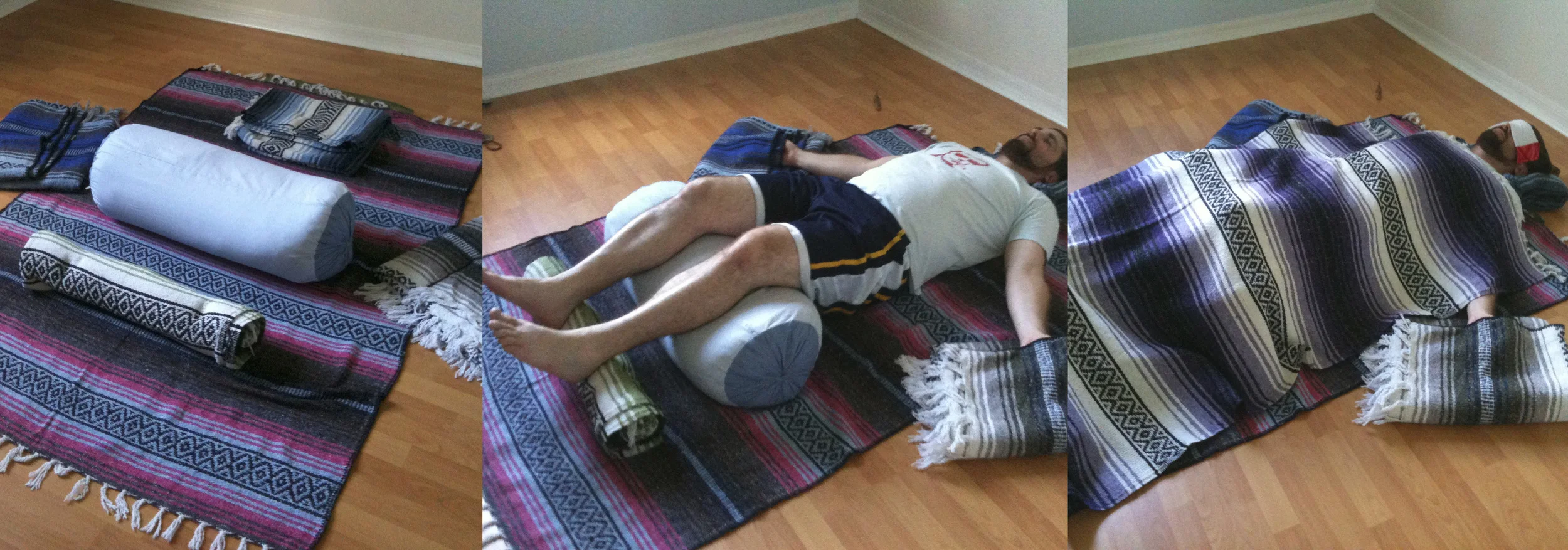
“It is yogic sleep, which means the deepest state of rest with only a trace of awareness.” -Rod Stryker
Yoga Nidra, a.k.a. yogic sleep, is an ancient systematic approach to complete relaxation. It helps you formulate positive feelings surrounding your sankalpa and its effects trickle into the rest of your life. Your ability to reach your sankalpa increases through the process of yoga nidra — when there is deep effortlessness you become more aligned with the power of your unconscious rather than in conflict with it. Yoga Nidra is the process that gives you the tools to peel away all negative associations related to your sankalpa, including doubt.
Practicing this technique helps you gain access to a state beyond both intellect and effort. It affects all aspects of your being: physical body, energy body, mind and unconscious soul. The technique reduces stress and promotes healing while allowing you to access the unconscious.
If you haven’t yet practiced Yoga Nidra, think of it like a long savasana or deep rest where you ideally don’t fall asleep. When practicing, it’s best to lay down in a super supported posture on your yoga mat, with a little extra padding. You can also do it in your bed, but that may lead to a nap rather than yogic sleep. Please make sure you are warm enough: cover yourself, your feet, and eyes with an eye pillow or scarf to keep it dark. If you do fall asleep, don’t worry, everyone has fallen asleep once or twice. The more you practice, the more conscious the rest will become.
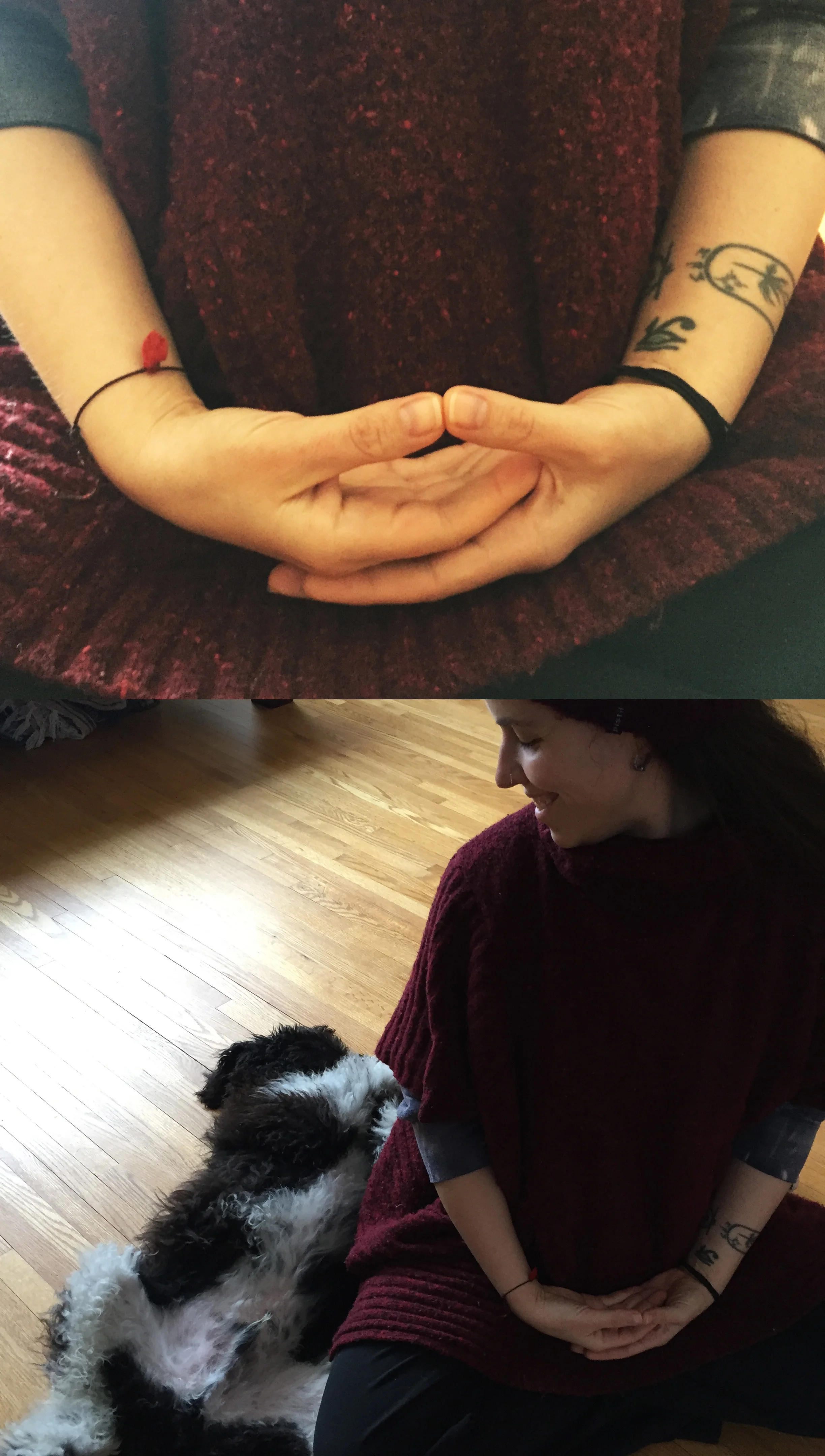
Bhairavi Mudra
At the end of the Garden Nidra practice, I offer this mudra to honor the guiding creative feminine force within each of us. It connects us to the second chakra and the pelvic plexus.
In your lap, place the right palm over the left, thumbs touching, fingers relaxed. Practice approximately 5 minutes.
Accessing the Unconscious
At the beginning of most Yoga Nidra practices there is a space to plant your sankalpa, and then again at the very end of the practice. In this space you want to remember the feelings you wrote about, as well as the creative work you have made to find more clarity around what your resolve looks like once it is realized.
The conscious mind uses words and information as expression, whereas the unconscious expresses itself though feelings and images. With practice, Yoga Nidra has the power to “bridge conscious intentions to your unconscious mind.” (Stryker, 2011) It unwinds the unconscious to seed the sankalpa deep in the loosened moist soil: this way the sankalpa has space to grow and become fruitful.
When practicing Yoga Nidra, remember that this is not a practice you do, but an experience of deep rest. Take some time to nourish yourself with this delicious practice.
I am honored to have shared this journey with you, and wish you all the best in the fulfillment of your intention, goal, sankalpa as the moon continues her ritual. Please know that the lines of communication are open, for added support and on-going inspiration. For those of you I haven’t met in person, I look forward to meeting you in the near future and for those of you who I know, I hope to see you soon.
Thank you again, for being part of this amazing creative mandala, you have all shared your hearts and made a beautiful sacred circle.
Aim Your Creative force—Always,
Chanti

Those of you interested in continuing as a group I will be offering two online check-in’s, this group will be limited to ten students—check it out if your interested, HERE
Please take some time to fill out our questionnaire to continue to make our programs greater!
Day 30: Cultivating Dhi—Your Gut Knows
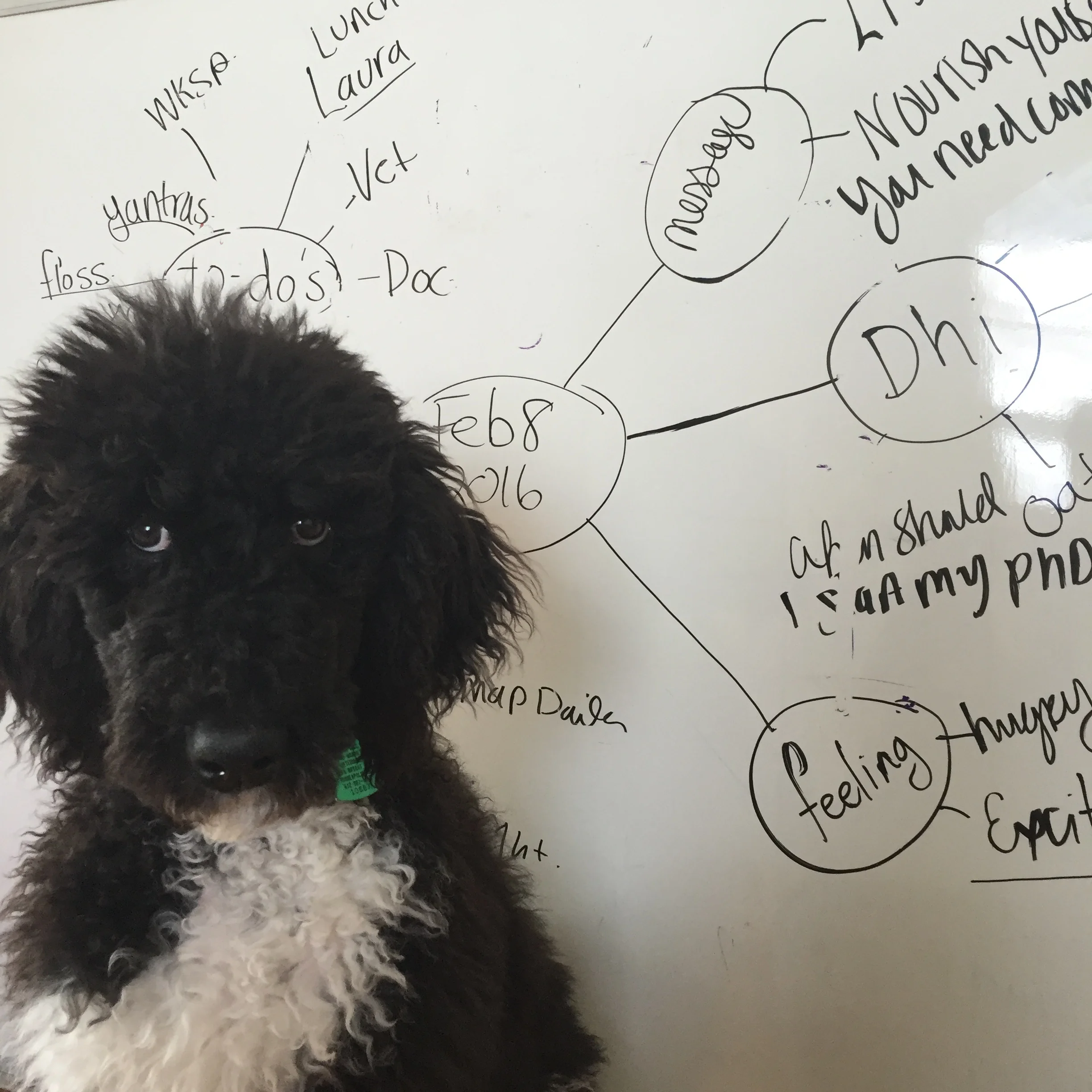
“For intuition to grow as a force in your life, you gain the courage and learn to honor it. One form of neglect is not taking time to hear it; the other is ignoring what it is telling you to do.”— Rod Stryker
It’s powerful medicine to “know your gut” on a sankalpa journey. Unfortunately we don’t really have access to tools that will help us get a better understanding of our intuition. Dhi means “intrinsic awareness, what is sometimes called called a ‘gut feeling’ or ‘knowingness”’ (Stryker, 2011). It is the higher aspect of the mind, which guides with precision the inner guru or teacher, our own personal north star.
Having a relationship to intuition just takes practice. In today’s video tutorial I outline a simple yet powerful daily practice that can be part of your meditation ritual. It allows you to take time each day to interface with Dhi, therefore strengthening that intuitive muscle.
Password for video is: icaniwillimust108
Here are some other ways to connect with your inner teacher, gain mastery and be a better listener while you practice the daily mind map, or throughout your day.
-Quiet and Complete- To settle the mind you need quiet and inner silence. You want to feel complete before you ask your questions to dhi. I feel the more you do this work, the more complete you feel: the questions and answers come more fluidly or without much effort.
-Sensing the inner teacher, Dhi, as a flame- To feel the presence of the inner teacher, it is helpful to locate its place in the physical body, you may also experience it as a light or a flame.
-No Expectations- Be open to listening without expectations.
-Ask a Question- When starting you can make it simple with questions that you already know: “What should I have for breakfast?” The simplicity of the question allows the answer to come quickly and you begin to have a relationship with that voice of guidance, of Dhi.
-Listen- As the listener you want to be in a quiet, open space where you trust that for every question there is an answer (or for every answer a question). If you don’t hear anything or it’s not clear, then return to being quiet, sense the inner teacher, and ask again without any expectations.
-Honor Your Voice- Listen to the inner teacher, intuition, be grateful and respond by doing what it says! It can be helpful to write down answers to take action later if necessary. This could be seen as the instinctual part of ourselves, our animal nature. Like von Franz (1998) mentions in Shadow and Evil in Fairy Tales, when characters in fairy tales go directly against the advice of the animals they're screwed!
The following image will help support the ideas mentioned in the video. The tutorial gives you the step-by-step guidance on how to build your daily mind map.
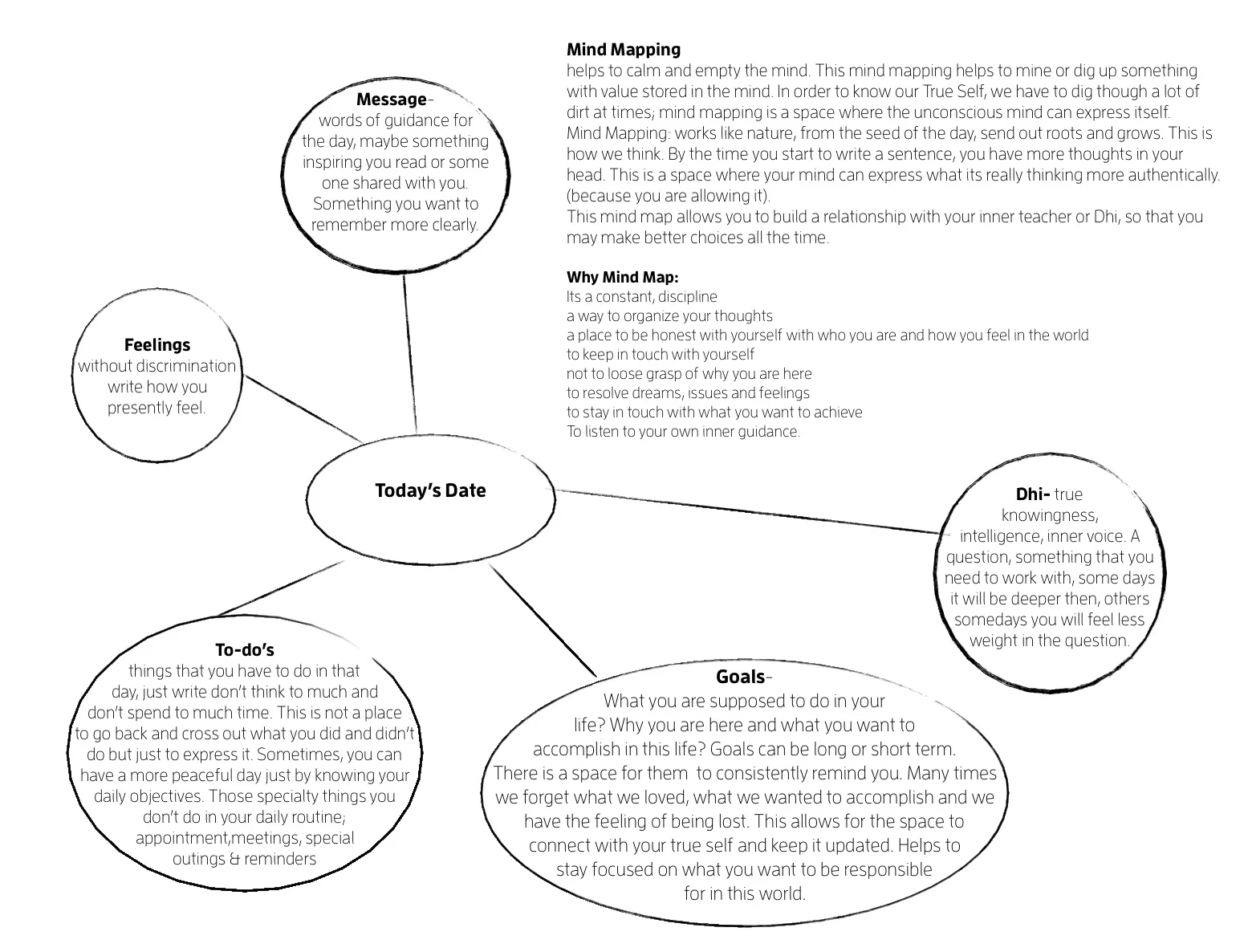
The following pdf will help support those ideas mentioned in the video; the tutorial give you the step-by-step guidance on how to build your daily mind map.
Day 29: Translating Word into Image
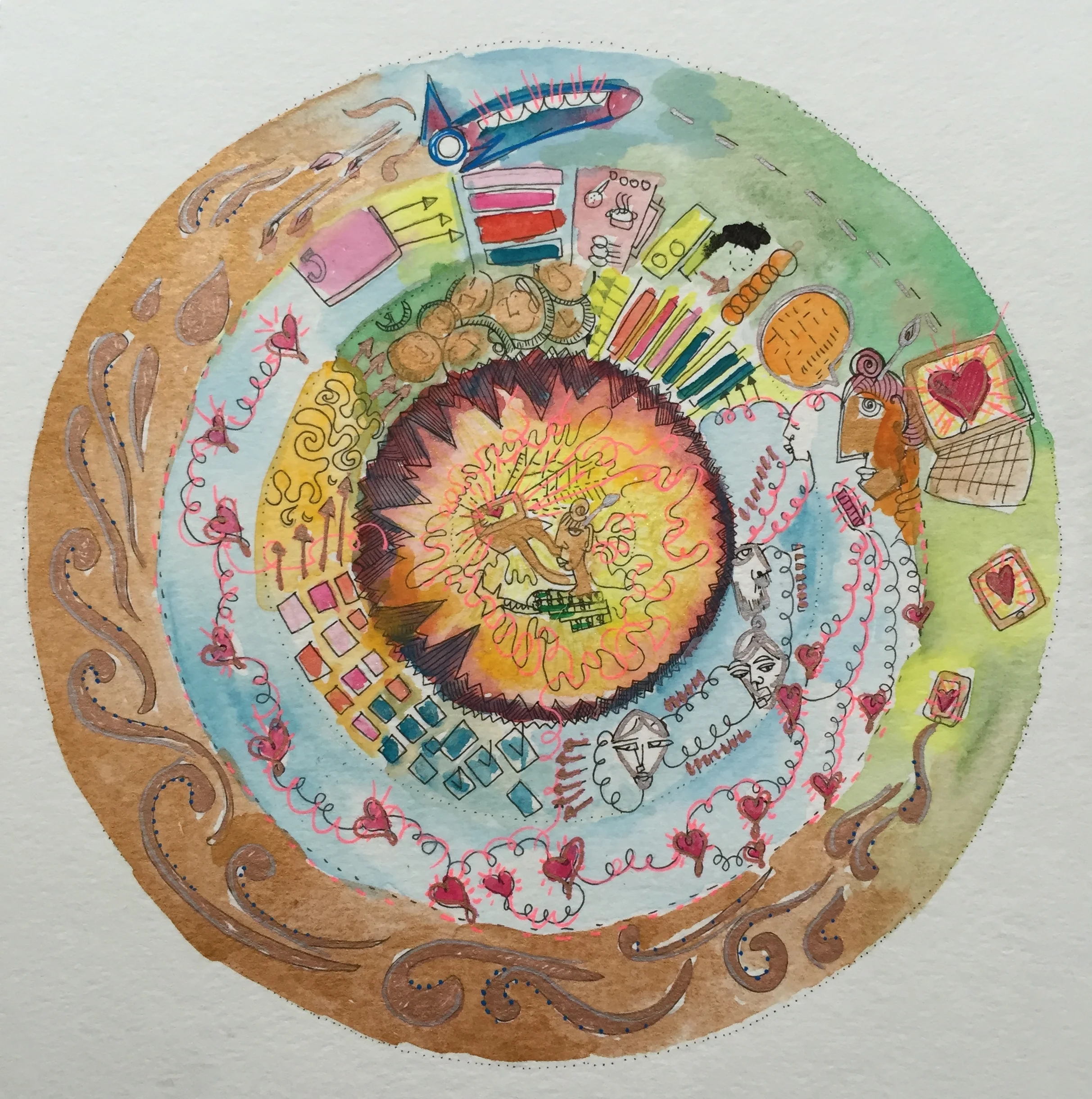
Jung (2009) developed a technique to “get to the bottom of [his] inner processes…to translate the emotions into images…and grasp the fantasies which were stirring…” Today we will go on a similar journey using the same mandala shape used in yesterday’s creative exercise and translate those words into the language of the unconscious — an imaginal reflection.
There are numerous ways to interpret words into images. The first is using a literal sketch, as if you were illustrating the scene or feeling of the words. The second is via symbols, which make it easier if you are not comfortable illustrating: sometimes symbols hold a deeper sense of the word for us. The third would be to collage. You can also use a combination of sketching, symbol, and collage to find depth in your translation. Honestly it’s best to use what you’re most comfortable with, so that you are not involved too much in the making, but more in the translating.
In my own illustration I am using literal sketch coupled with symbols, I have also used the colors as a symbolic representation of my own sankalpa. It doesn’t have to be obvious to anyone but your inner self. This process is a discovery of what may be hidden or disguised within. If you do have an insight during the process, it’s helpful to take notes to remember later or add to your sankalpa.
I highly recommend that you do not use words in this mandala, so that there is a completely different feel to this process.
This exercise may be a stretch for you: remember it’s about the process not the end product!
Mandala Image
- Print out or draw a mandala with 5 rings.
- Then, illustrate in sketch, symbol, collage or combination of these the following:
- Circle 1 — Your sankalpa
- Circle 2 — The resistance you are currently feeling around this sankalpa
- Circle 3 — The miracle angle in response to the resistance
- Circle 4 — The actions you can take towards this sankalpa
- Circle 5 — The reward. Thisimage may go beyond the actual sankalpa if you are using the sankalpa to get you to a specific point, which together adds to a bigger goal.
Stretch your creative force,
Chanti
* References:
The Red Book by Carl G. Jung
Day 28: Weekly Checkin’s
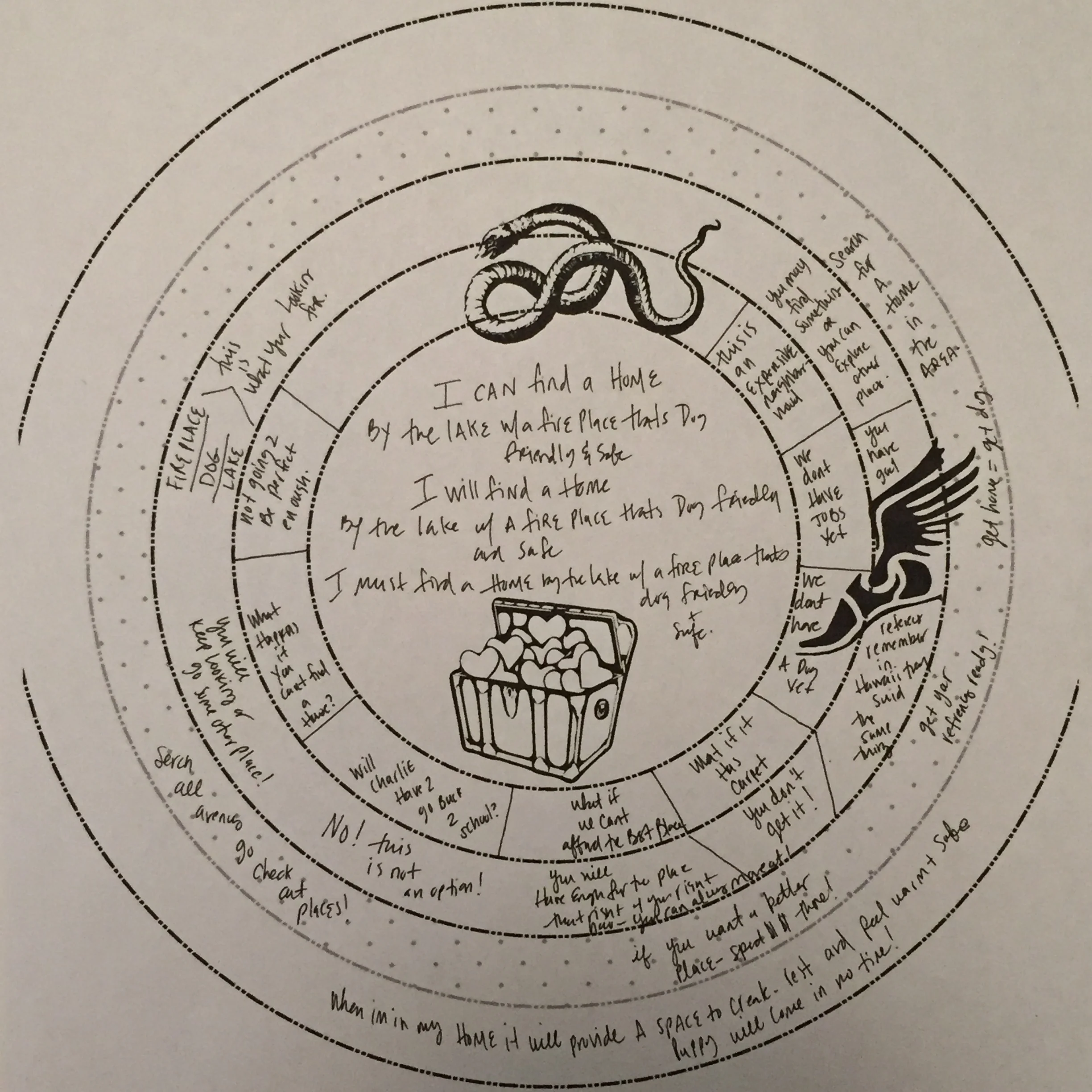
I know it’s a lame title, but it’s what keeps us on course. The best way to engage with this deep work is, most importantly, with community. The second best way is ritual. I am offering you a way to look at the Creation Equation in a new light, meaning in your life and in practice, every week. We can look at that equation and ask, “What side of the equation am I on?” This helps us move forward and see what is in the way.
Through my own expiration of resistance, I feel that keeping a creative record of where I am is helpful. I often visualize sankalpa work as a treasure map where the treasure (your sankalpa) is clearly outlined. On ancient maps, there are imaginal creatures drawn on the water similar to the resistance that may come up on your journey towards sankalpa, as well as islands marked where provisions and hospitality are available.
With this Creative Equation Mandala you can keep it simply to words, or you can make it more interactive. To experience both of these we will test them out. For today, we will write.
At the center of this mandala is a treasure chest, symbolic of your sankalpa. In this center, write your sankalpa in whichever way is resonating with you most. As an example I will use the Swami Rama approach: “I can find a home by the lake with a fire place, that’s dog friendly and safe, I will find a home by the lake with a fire place, that’s dog friendly and safe, I must find a home by the lake with a fire place, that’s dog friendly and safe.”

Creative Equation Check-In Mandala
The next circle moves you to the resistance. What is your current resistance like?
My resistance tends to reveal itself as “what if” questions, or as the voice that says, “You won’t be able to…” This is just an example, it may come up in a different way for you. When doing the check-in, it’s important to reveal the actual resistance that has come up for you within that week.
For me, it was: “the rent was not worth the place; we don’t have jobs yet; you won’t get it, you don’t even have a dog; these places are not meeting my needs!; what if you don’t find a home; they didn’t want you. :(”
The following circle, gives you a chance to see the resistance’s Miracle Angle. Hermes is the greek god that rules the spaces in between, whom can easily cross over from resistance to assistance. Your ability to cross over and see the resistance from another angle will mobilize your energy towards taking action in the direction of your sankalpa, rather than getting stuck in the pool of resistance, or drowned by their enormity.
Examples
the rent was not worth the place—> there will be better places
we don’t have jobs yet —> you didn’t need a job when you got that great place in Honolulu!
you wont get it, you don’t even have a dog—> you will have a dog, many people get dogs in the middle of a lease
these places are not meeting my needs—> there will be something that you like, be patient!
what if you don’t find a home—> then you will go somewhere that there is a home for you.
they didn’t want you :( —> it’s not really you, it’s you on paper, and perhaps it’s not the place for you
The next circle allows you to take those miracle angles into action. Using my examples, I made it a point to see more houses and to contact the family that we rented from in Honolulu, for references. There may be one or many directions that the angles are leading you towards.
The final circle, is to remember how much you want what you want, the intensity of shakti — a reminder of the feelings in your sankalpa. What does your life look like when you achieve this goal? How close to your goal are you?
Day 27: Hello Change

““Intentions like all other forms of thought, are waves that silently ripple, expanding out from the mind and to the universe.” ”
Being able to see the resistance is key, and now you have some support around that.
Also, I want to mention that the refining process of a sankalpa will come organically. If you think big, there will be big hurdles, and sometimes the resistance indicates that there are previous steps you need to take before attaining this specific goal.
Sometimes just asking “is this something I can realistically achieve in the next 6-18 months?” is helpful.
One of the most powerful ways to move towards your sankalpa is by changing the direction of your energy. When you let something go, you change in many ways. Those changes can create a ripple effect strong enough so that the future itself changes. We don’t realize it, but letting go of something that no longer serves us begins to create positive change in us, and in turn the world we live in. We feel better about ourselves, we get the things that are really important done, or we simply have that extra hour to practice in the morning. All thanks to change.
Departure Point
The Departure Point technique is “based on the principle that by giving something up, you can create an opportunity for the universe to fill the resulting gap with something new, and specifically something you desire-your sankalpa.” (Stryker, 2011)
Remember that list you made of your time-suckers, wasters or bad habits? It’s time to decide what you are willing to give up to achieve your sankalpa. What you give up does not necessarily need to be linked to your sankalpa in any way, it’s the creation of space for something new that is paramount.
Steps towards “Seeding the gap”
The gap is the space of redirection: it launches the intensity of your bad habit, and redirects it towards your sankalpa.
First decide what you are going to give up, then have two back-ups. For example,
if you give up Netflix binging, it may be as easy as cancelling your subscription, you however want to make sure that you are engaging in the behavior. If you give up Netflix and cancel your subscription, there still may be times when you think about it, but not as frequently. Thus, having a back-up is important. Once you are not stirred by your first bad habit or time-waster, you move on to the next, until you achieve your sankalpa.
- Netflix binging
- Checking email before meditation practice
- Walking and texting
Next is the process that I remember as Stop, Drop, and Roll, like they used to teach us in school in case of a fire. The fire is the bad habit, this method links you to what you really want to achieve.
When you feel the impulse of the bad habit, even just the thought of it: you stop.
- STOP — Stop moving towards the bad habit, don’t satisfy the urge!
- DROP — Drop your attention to divinity, or whatever you consider more powerful and greater than you. Surrender to this divinity and away from the urge.
- ROLL — Roll your sankalpa out. Remember to feel it and repeat it internally 3 times.
- Then, feel gratitude!
Why this method works (if you do it)
Vedic wisdom describes the mind as a body of water. In that body of water are many thoughts, and each thought is like a ripple. At times the mind is comparable to a choppy sea; other times it’s a surfer’s dream swell. When we learn how to quiet the mind and “still” the waters, we can drop an intention (sankalpa) into this stillness to expand (as energy) towards the universe, free of distortion. The energy of thought, when powerful enough, is transformed into the material world. An intention formed in turbulent waters will have less potential to expand. This is why when practicing the departure point exercise, we stop and create a connection to a Higher Source.
Today you begin this journey. Decide on your bad habit, use it as your departure point, and practice seeding the gap. Each time it happens, you get the opportunity to remember your sankalpa.
Day 26: Ganesha-remover of obstacles


What amazing work you have done! It’s time for some devotion, coloring, and mantra! Let’s spend some time with Ganesha, as a stepping stone to continue towards your soul’s desires.
Gana- all existing (names and forms)
isha- lord
Ganesha therefore means god of all beings and creation.
There are many stories of how Ganesha, the son of Shiva and Parvati, got his elephant head. For some it is hard to see the Divine in this pot-bellied god and his coarse appearance. Ganesha teaches us acceptance — a divine force that supports us in ridding the rational mind of its doubts and our greatest enemies (kleshas).
This is why Ganesha is worshiped as the great obstacle remover. Ganesha is unshakable. He provides firmness to those who meditate upon him. Meditation on the Ganesha yantra inspires balance.
As you color in the yantra, feel free to chant this mantra (that which protects the mind), or any other Ganesha mantra you may know, including the Para Yoga invocation.
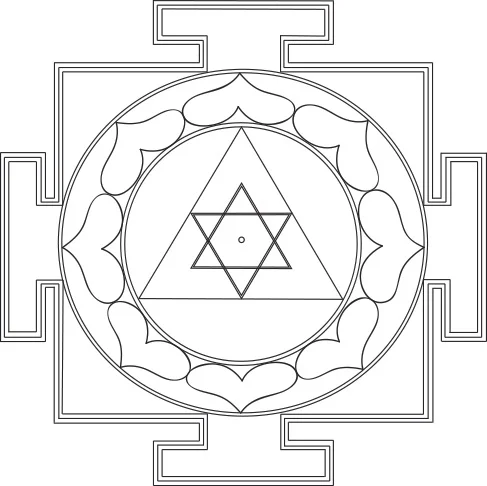
COLORS IN THE YANTRA
Bhupur- First line: gold; second line: lemon yellow. The radiant green made from hot yellow and cold blue create a balance. Meditation on this color produces complementary red: the color of life, inspiration, revolution, freedom from rules and regulations.
Petals- The eight petals of vermillion color represent Prakriti, the 5 elements and 3 gunas. Akasha or Space, air, fire, water, earth, sattva (illumination and light), rajas (activity and energy), tamas (nature of stability). Inside the petals is a darker red then the petals themselves.
Triangle- This triangle is symbolic of immortality. It is the color of Ganesha’s skin: a saffron hue.
Star- The yellow-colored six pointed star represents Prana and Apana. An upward pointing male and downward pointing female energy. This is the direct representation of alchemical balance. The outline of this star is the same color as the petals: vermillion orange/red.
Bindu- The central point in the middle of the triangle is Ganesha, and is gold in color.

Day 24: Putting together the Pieces
"Once you detach yourself from your grievances, however justified they might be, and you abide within the perspective of your Miracle Angle, you will find yourself embracing the gift of life and living it more fully.” — Rod Stryker
For the next two days you will continue the work of creating your three-dimensional talisman, to redirect your resistance. If you are new to this process of making something with your hands, you may feel a similar resistance just thinking about where to start. There really isn’t a specific way to start, other than laying out all that you have gathered on a table and allowing the image to filter through your body into your hands to choose the objects that will create the image.
At times this creative work becomes a challenging passage because its nature is to move thatresistant energy that may be lingering within you to give it a physical shape outside of you. However great that may sound, it then provides you no reason NOT to move towards your sankalpa.
Let’s look at the Miracle Angle one more time, and put it into practice as we create this talisman. A Miracle Angle finds the positive perspective in a painful situation. When you find it, there will be less or no suffering — a sign that you have reshaped your perspective. If you are still suffering, you either haven’t found it or haven’t embraced it. There is always more than one way to look at a situation, we need to give ourselves permission to do so.
Day 23: Hunter Gatherer

A talisman is defined (in Webster) as “an object (such as a ring or stone) that is believed to have magic powers and to cause good things to happen to the person who has it.”
The Miracle angle as defined by Stryker (2011) allows “us to see the potential for something good in even the most painful experience.” If we are able to look at our resistance, and find the positive potential, we then begin to move from being bound by that resistance to being unattached from it, because we have the ability to see from a new angle.
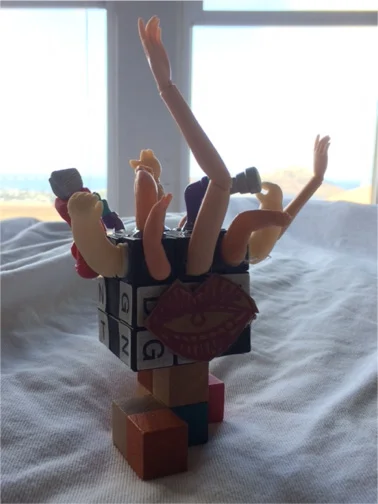
When I amplified my Distraction sketch, it reminded me of all the things that I needed to do before I could sit and write. I was distracted by laundry, the house not being clean enough, feeling obligated to cook, to support my community, to be up-to-date on everything, to give advice, and to stay in communication with friends. Basically everything became a distraction. Distraction was my big resistance. Following my sketch, I created a three-dimensional object that allowed me to be reminded to redirect my energy. It truly embodied the magic powers that a talisman holds and became the fuel for me to buckle down and write, rather than be distracted by it’s multiple arms trying to get my attention. After I created this totem, I sat for approximately six hours and wrote, it was a turning point I never thought would happen. I still place my totem in my sacred space or next to my computer to remind myself that the task at hand is what’s important, and that I have the power to redirect Distraction.
Hunter Gatherer
Today you will be a hunter gatherer: your task is to find objects in order to create a three-dimensional representation of your sketch. We have a few days to work on this. Spend today gathering things you may want to use. A hot glue gun is a great tool for creating something 3-d, it’s quick, fast, and it sticks. You want this talisman to be portable, so keep it on the smaller side rather than making something big.
I suggest you start at home and see if you have anything you can use to bring your sketch to life. Another great place to look is at your local second-hand store.
Options & Ideas
- Stuff a sock with newspaper, cotton batting, a cut-up old t-shirt and use a Sharpie marker to give it accents, or sew some buttons on it.
- Find a rock, and decorate it.
- Use a paper cup as a base to work from.
- As an alternative, you can create a 3-d collage, using a small box to project your images on.
I know we all don’t have the supplies or skills to make the perfect relic, but I promise you if you hunt and gather in the same manner that you looked for your images in the magazines, the perfect tools will find you. I want to remind you now that it’s more about the process of creation than it is about the final product. Since I created Distraction, three of his arms have fallen off, and some of the sticker letters too. I have the hands next to it, as if waiting for them to be glued back on, but I’m not getting distracted by that.
Please feel free to contact me if you have any questions about this project as I know it may be challenging, I am happy to offer my support.
Aim your creative force, and happy hunting!
Chanti
Day 22: The same power that binds us liberates us—A Rough Sketch
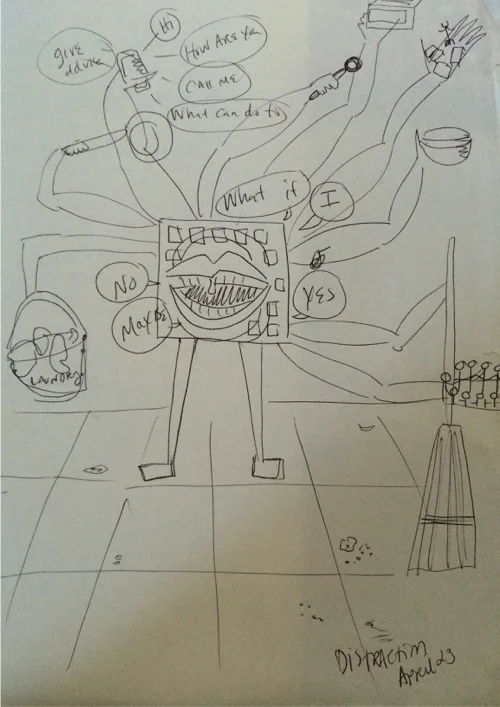
After writing your poem, can you see how the redirection of this energy can begin to support exactly what you want? Can you sense or feel simultaneously how that power that binds, can liberate? Often times I have this same feeling in deep rest, where my body feels heavy as if it could sink into Earth and at the same time feels light as a feather.
For the next 4 days we will be engaging with the resistance side, which can teach us a great deal and perhaps aid in redirecting that energy towards what our soul truly desires. We are going to allow our poems to come to life, and see the image that the poem is illustrating. Feel free to listen to the recording beforehand without doing the practice, and then a second time to engage in this exercise of amplification—a Jungian therapeutic technique which correlates the “image to symbols, archetypes, and figures from mythology, fairy tales, literature, theatre and other forms of cultural expression.” (Aizenstat, 2011)
Supplies needed:
- Props for short seated centering
- Paper or your journal
- Pen, pencil or any sketching tool you prefer.
- Your poem “To Resistance”
Warmly,
Chanti
Day 21: Observing Your Time
We are in a part of our creative process that requires a little more looking and watching rather than doing. Sometimes creatives call this an incubation period, where space is produced to support the making of something greater.
I remember an exercise that one of my college professors had us do. She asked us to answer this question: “What gets in the way of creativity?” My answer was not surprising. Nonetheless what came with that awareness still helps me today to redirect my focus from the resistance part of the equation towards achieving my goals.
For today, you are going to observe what is wasting your time. What is sucking your energy? It’s important not to get caught up in trying to change that behavior. Do it while observing it. Sometimes we don’t even have to observe our life to know what those time-wasters are, but do it anyways,. You, too, may be surprised.
You may spend lots of time cleaning up, or reading your email, or responding to email you don’t really want to respond to, or lingering on social media. There may be other time usurpers that are hidden, perhaps it is something that you may not see at first as being a time waster, but is still calling for your attention. Of course, this question is as relative as your own definition of time, so everyone will have their own experience of it. When I saw it, it really stood out.
You can make some notes if you like, but it’s more about the feeling you get. So maybe add to your notes the feelings associated to observing yourself and questioning what consumes your time.
If for whatever reason you don’t find yourself wasting time today, take another day and see how it goes. Or, if you know what wastes your time and it didn’t happen today, make notes on the observations and feelings on that particular thought.
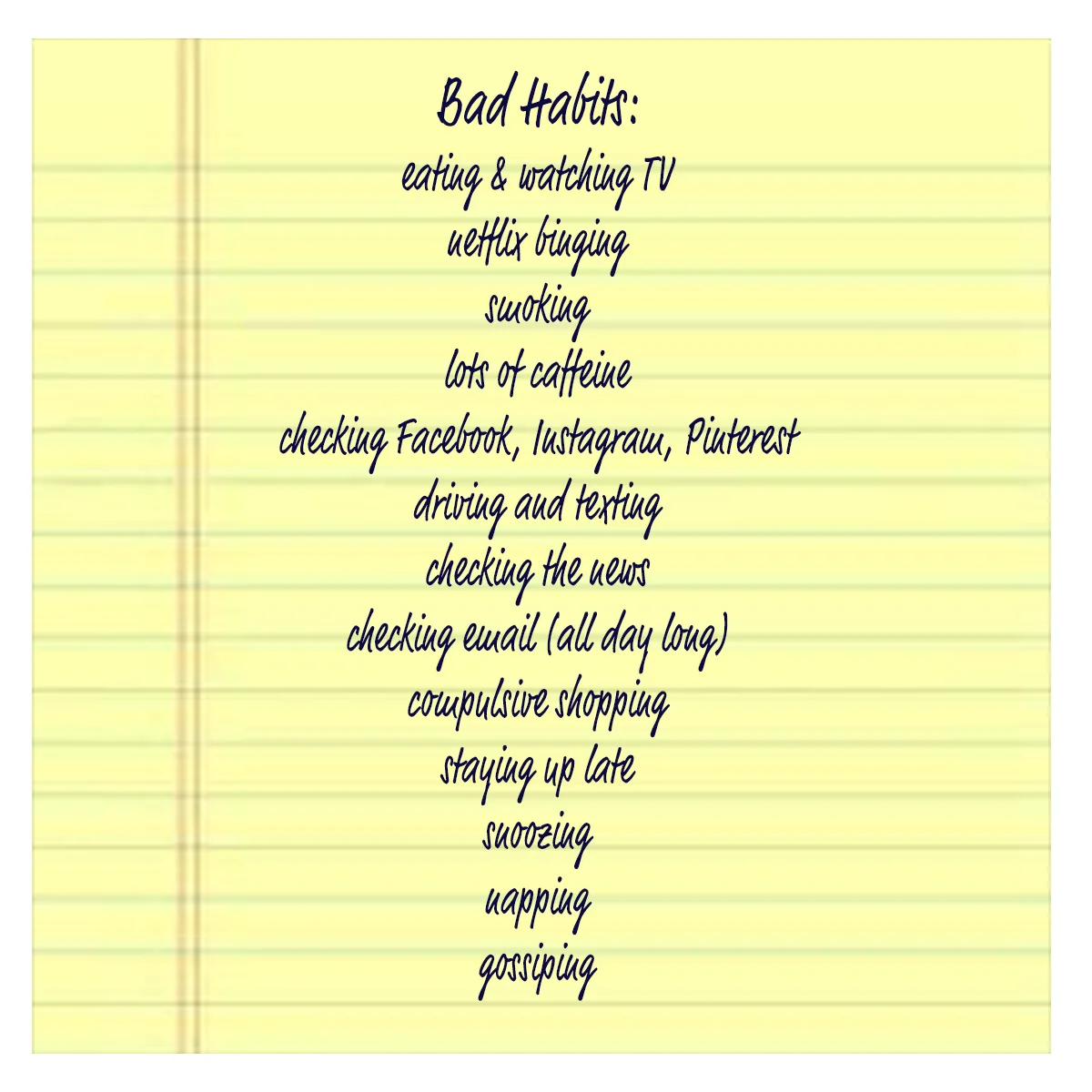
Then make list of your “bad habits.” We will be using the time wasters and your bad habits as a way to launch your sankalpa into the universe and start a new path!
Examples of Bad Habits and Time Wasters
- eating & watching TV
- Netflix binging
- smoking
- lots of caffeine
- checking Facebook, Instagram, Pinterest
- driving and texting
- checking the news
- checking email (all day long)
- compulsive shopping
- staying up late
- snoozing
- napping
- gossiping
Day 20: To Resistance, A Poem
One of the teachings of Sri Vidya states that the yogini or power that binds us is the same power that will liberate us. I can’t help but deeply feel this concept, and from that very palpable feeling comes an image. In this image, I sense a ball of energy and there are movements from one side to the other, from bound to liberated, from obstacle to opportunity — without judgment on these opposite ends. Truly it’s more movement towards purposeful action. Is there anything else really worth doing?
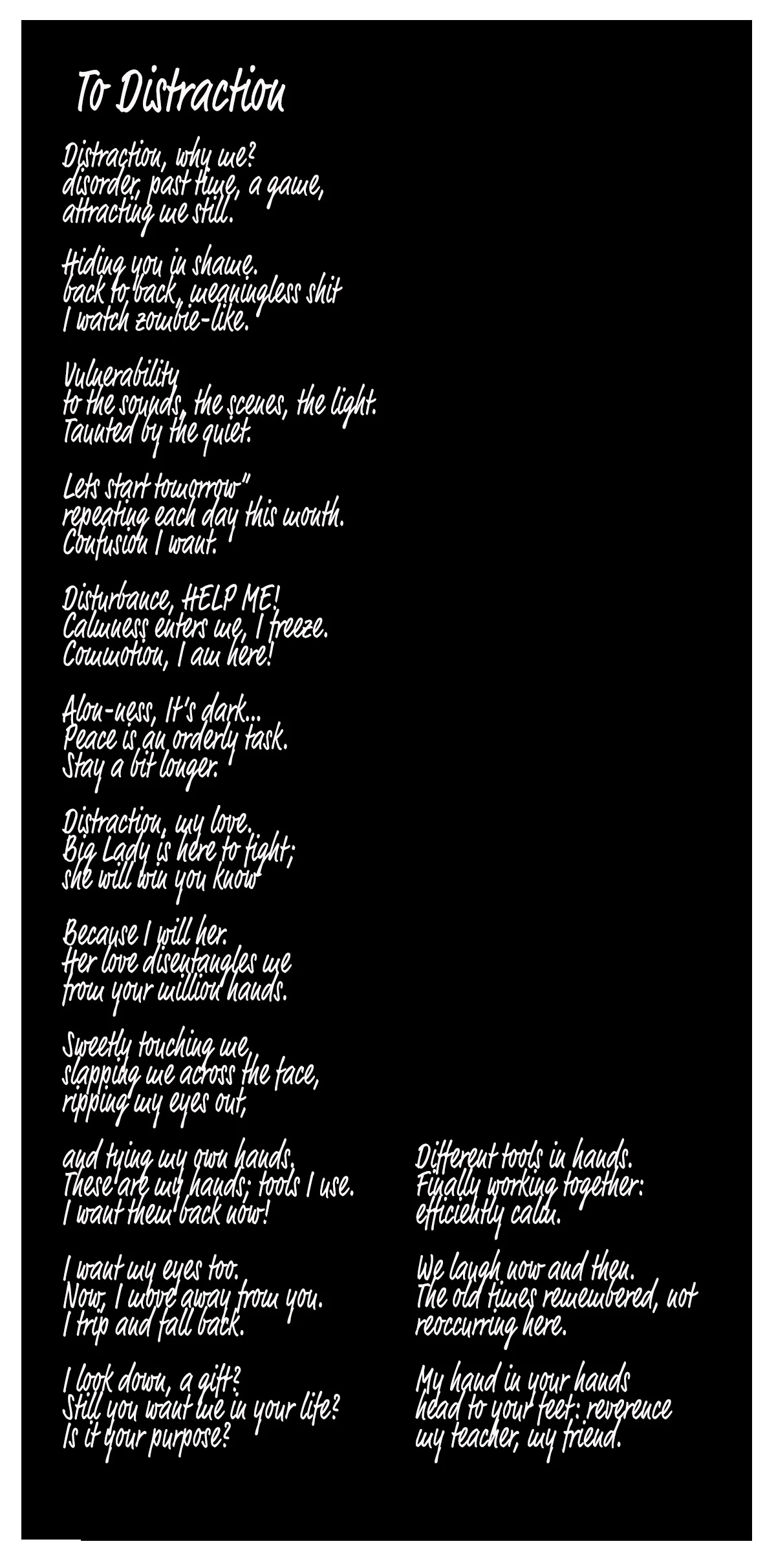
With that understanding we are going to write a poem to the resistance circling our sankalpa. Look back at yesterday’s recurring resistance: what can you call it? I called mine Distraction.
I share with you the poem I wrote to Distraction, to look at it in a new and curious way rather than feeling shame or beating myself up for not being as productive as I would like to be.
Here are some questions to help you formulate your poem, or to use as a starting point:
- What is the recurring resistance from yesterday’s writing exercise?
- How does its arrival make you feel?
- How does its arrival make you react internally?
- How does its arrival cause you to react externally?
- What is the size of the resistance, or how much space does it occupy?
- What is its temperature?
- What does the resistance sound like?
- What does the resistance feel like? Does it have a specific texture?
- What does it taste like?
- What color is the resistance?
- Does it feel masculine or feminine?
- Does the resistance have a shape or distinct contour?
- What does the resistance look like?
- Is there anything useful to learn from this resistance?
- If the resistance was a cartoon character, what would it look like?
- What is the name of your resistance?
Take a few minutes to write a poem or free verse to your resistance allowing yourself to look at it in a different light, not just as resistance but as the reverse side of that Shakti.
Aim your creative force by honoring the other side,
Chanti
Day 19: What’s in your way?
“For every resolve, there is always at least some resistance to its fulfillment.” — Rod Stryker
Now that you have a clear picture and feelings of your soul’s desires, how much do you really want it? What’s in your way? Let’s face it, even when our soul wants something, the body, it’s environment, life’s patterns, and Julia Cameron’s “crazy-makers” (those special people who always get in the way, remind you of your resistance, are melodramatic, expect special treatment, may not have your best interest at heart, and who drive you crazy!) can easily get in the way. As we find ourselves at the center of this creative journey, I am confident that there is enough support, strength and creative fire to look into that darkness with courage. Knowing the resistance to our desires is equally as important as knowing what we truly want.
Stryker proposes the creation equation to observe the different energies at play around desire.
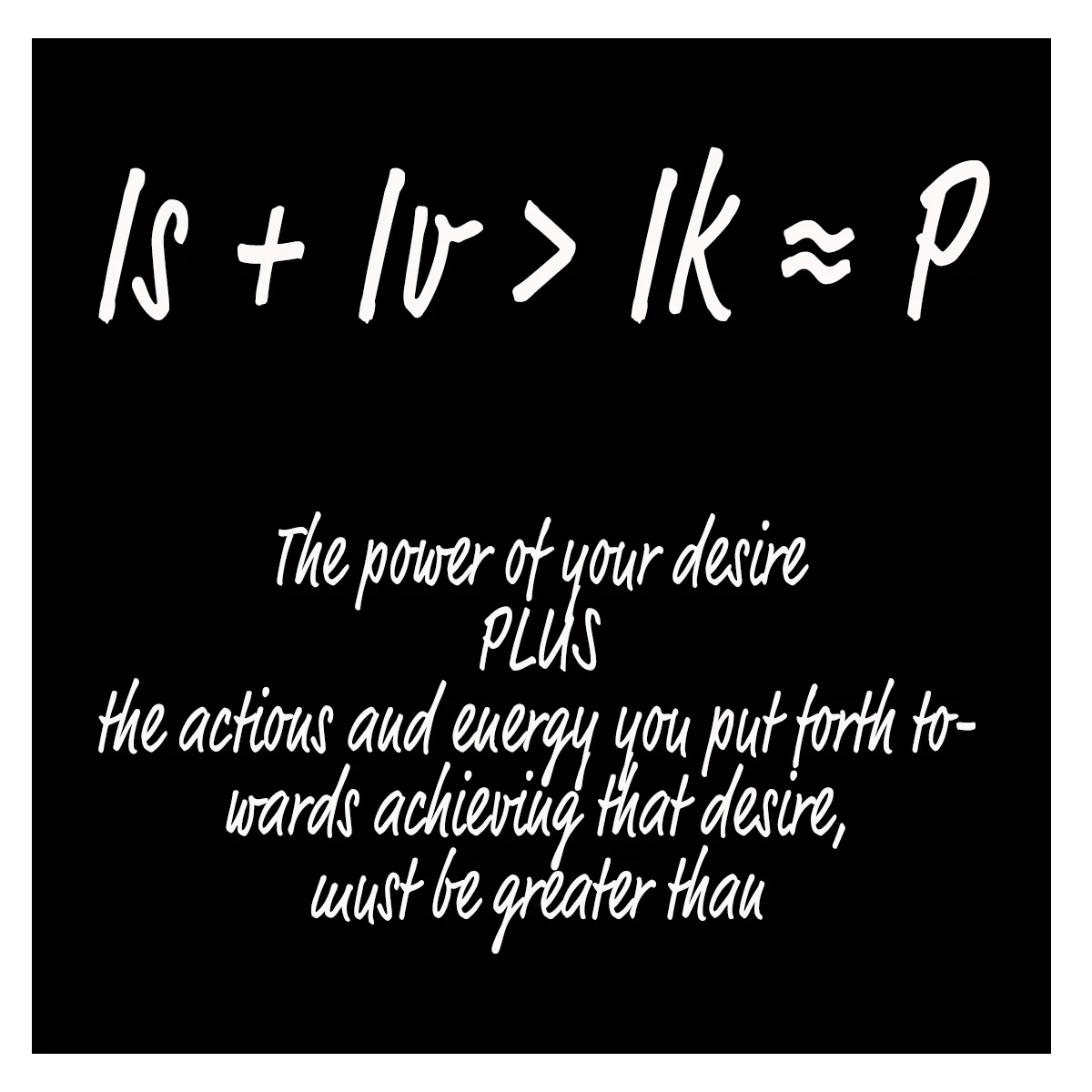
It’s basic formulation states that to reach Prapti (P), the fulfillment or attainment of your desire, the Intensity of shakti (Is), the power of your desire, PLUS the intensity of vayu (Iv), the actions and energy you put forth towards achieving that desire, must be greater than the Intensity of karma (Ik).
(Is) The intensity of Shakti is the energy behind your initial impulse or desire. It is what lights you up to fulfill a specific desire. The more you want it, the more potency there is against the resistance to successfully achieve your goal.
(Iv) Intensity of Vayu is the total energy you direct towards fulfilling your resolve. This is your personal energetic investment made to fulfill your desire. It is the expression of your shakti; how you interface with “will power, discipline, love, finances, networking skills, patience, forgiveness, self-acceptance, intelligence, self-study, clarity, discernment, laughter and joy.” (Stryker, 2011)
(Ik) Intensity of Karma in this context is the total resistance that obstructs you from fulfilling your desire. This includes both internal and external resistance. This part of the equation can represent our own self-doubt, physical and emotional barriers, financial struggles, opposition, health problems and, of course, the “crazy-makers.” Also in this category is vikalpa — that which separates you from your dharma, your soul’s purpose.
(P) Prapti is the sanskrit term for the attainment of your desire.
Today we are going to be working with karma or the resistance that gets in the way of our sankalpa. There are two kinds of resistance: internal and external. Internal resistance includes those obstacles that are in your control: lack of discipline, self-doubt, finances, a crazy-maker, deadlines, etc. External obstacles are those that you have no control over, like natural disasters or the sickness of a loved one. Both kinds of resistance affect this side of the equation.
Here is our task:
Although not a difficult creative endeavor, it will set us up for a bigger project.
Supplies:
One sheet of paper
Pen or pencil
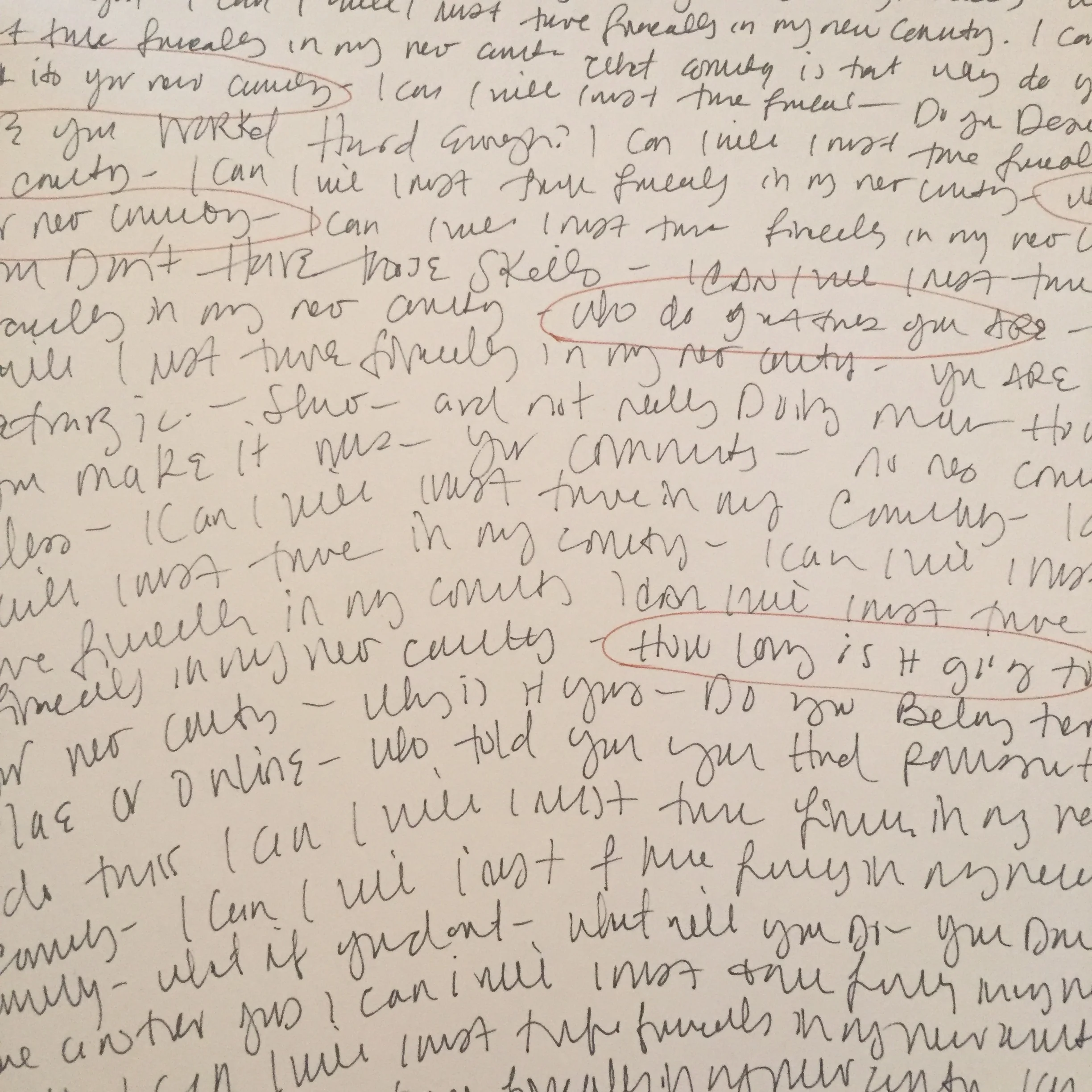
In your notebook, you are going to fill the page with your sankalpa, like in Likhita Japa, but this time you will listen for the resistance. Whenever the mind wanders from sankalpa to resistance, you will write down the resistance. This exercise allows for the resistance to come to the surface, and for us to acknowledge it. Then continue to write your sankalpa.
Funny, the last time I vividly remember doing this exercise I was also looking for a home… in Paris, France, where I felt more resistance than looking for a home in the United States. Much of what came to the surface was my inability to communicate, the difficulty of searching for a home, not knowing what was a “good” neighborhood, being able to afford a place in a good neighborhood, the feeling of not really knowing anyone, not having a job, my husband not having a job, my limited French vocabulary… you get the idea.
I allowed all these thoughts to come to the surface. As soon as that thought was gone, Icontinued writing my sankalpa. If the same thought persisted, I wrote it again until I felt like there was no more resistance lingering in my mind, or for approximately 7-10 minutes.
When you are done, look for the recurring resistance, circle or write it down. You’ll need it for tomorrow’s creative practice.
* Crazy-makers are those special people who always get in the way, remind you of your resistance, are melodramatic, expect special treatment, may not have your best interest at heart, and who drive you crazy!
References: The Four Desires by Rod Stryker
The Artist Way by Julia Cameron
Day 18: Lakita Japa--I can, I will, I must
To enjoy good health, to bring true happiness to one's family, to bring peace to all, one must first discipline and control one's own mind. If a man can control his mind he can find the way to Enlightenment, and all wisdom and virtue will naturally come to him. — Buddha
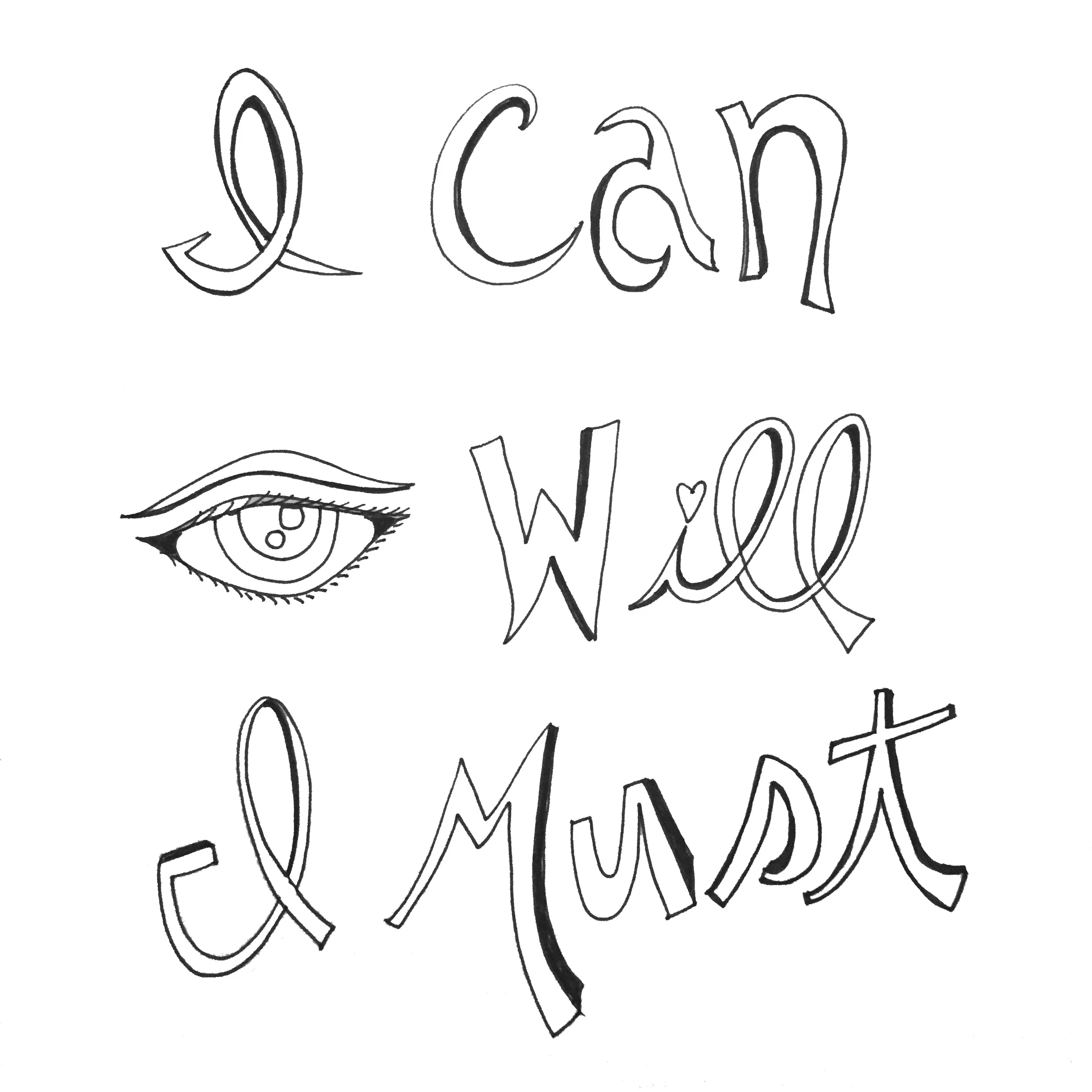
Very similar to yesterday, we will continue the practice of Likhita Japa. The difference being that today we will focus on using the second method: I can, I will, I must.
The pdf provided gives you a watermark to start, then add the rest of your sankalpa in light pencil, or you can create your own completely. Again the goal is to use this practice as a refining tool, to get a more detailed “image” and to clarify the words used in your intention.
Suggested Steps:
- Print out the pdf of I can, I will, I must
Add the end of your sankalpa to the template in pencil - Then begin the practice of Likhita Japa in pen, thin marker, permanent marker or the like, on each letter.
- If you find clarity or if a new word pops up make the change, then continue with the Likhita japa.
Clarify with your creative force,
Chanti
Day 17: Lakita Japa
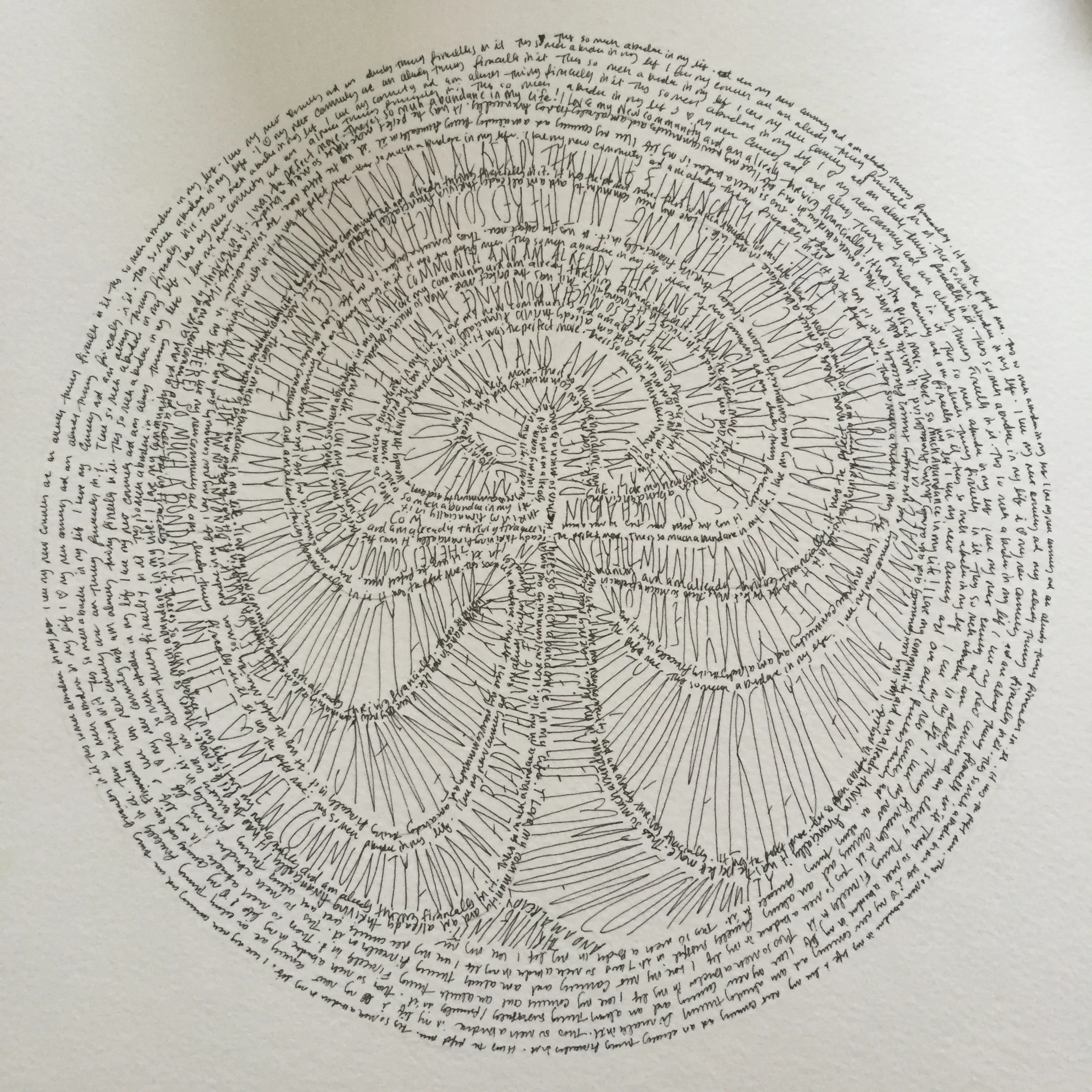
Likhita Japa is a written repetition. In this case it will be of your Sankalpa. Radha (1994) says, “Likhita can be done in any script, in any language… This repetitive writing brings peace, poise and strength within.”
It is also helpful to gain some clarity on the words, feelings, and details of your intention. Sankalpas need refining. Likhita Japa is a way to return to that sacred space of the heart and spend time listening as you write. This is especially true at the beginning of a new intention.
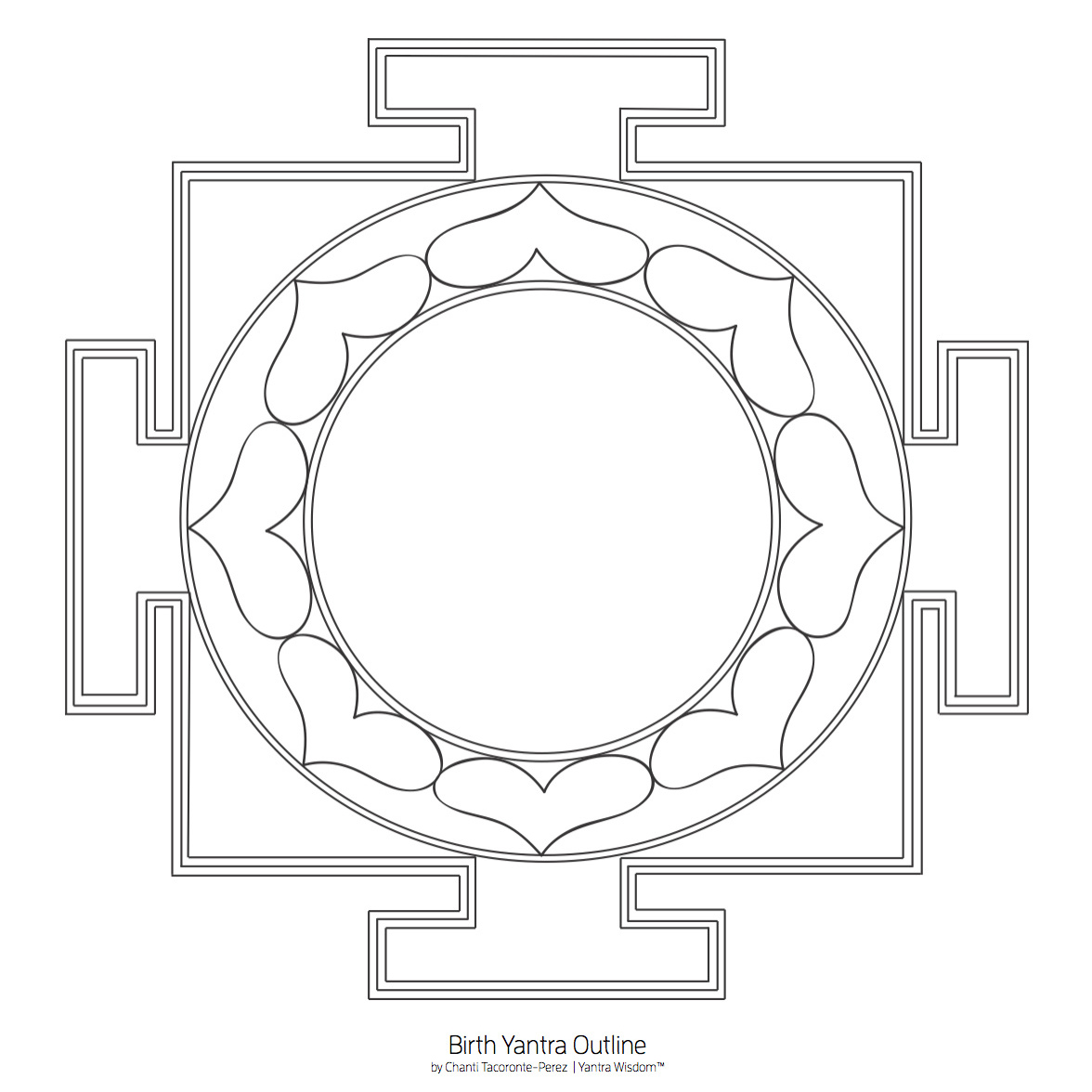
There are many different designs that you can use for this kind of japa. We will be using a labyrinth,as found within the birth yantra. This week’s video tutorial will show you how to draw the labyrinth, and apply Likhita Japa.
About six years ago, I asked one of my teachers, Pandit Rajmani Tigunait, about this yantra, since I didn’t have a lot of information on it. He told me that it represented the battle field of the Mahabharata, and that only Krishna and Arjuna (the protagonist of the Mahabharata) knew the secret to break this Chakra Vyuha (military wheel formation) or Padma Vyuha (lotus formation). Arjuna shared these secrets with his wife, Subhadra, who was at the time pregnant with Abhimanyu. Unfortunately, she fell asleep as Arjuna was explaining the exit strategy, so Abhimanyu never learned its secret.
Later on, when Abhimanyu fought in this epic war, he was able to enter the chakra, killing many at the heart of this formation, but he was unable to exit the spiral and was killed.
I really didn’t understand this story until many years later. It was the process of combining sankalpa work and this yantra that helped me understand that whenever we courageously fulfill our desire and enter the center of the chakra, a little part of us dies. We then move back into the world a new person — we must die to be reborn.
There is a part of us that must fight to get to the center of that labyrinth and be as heroic as Abhimanyu; the other part must be willing to metaphorically die. Likhita Japa reminds us of our goals, and it begins to show us a new way of being, in such a way that our hearts can hear the great lessons on how to find ourselves newly in this world, and walk our path back out.
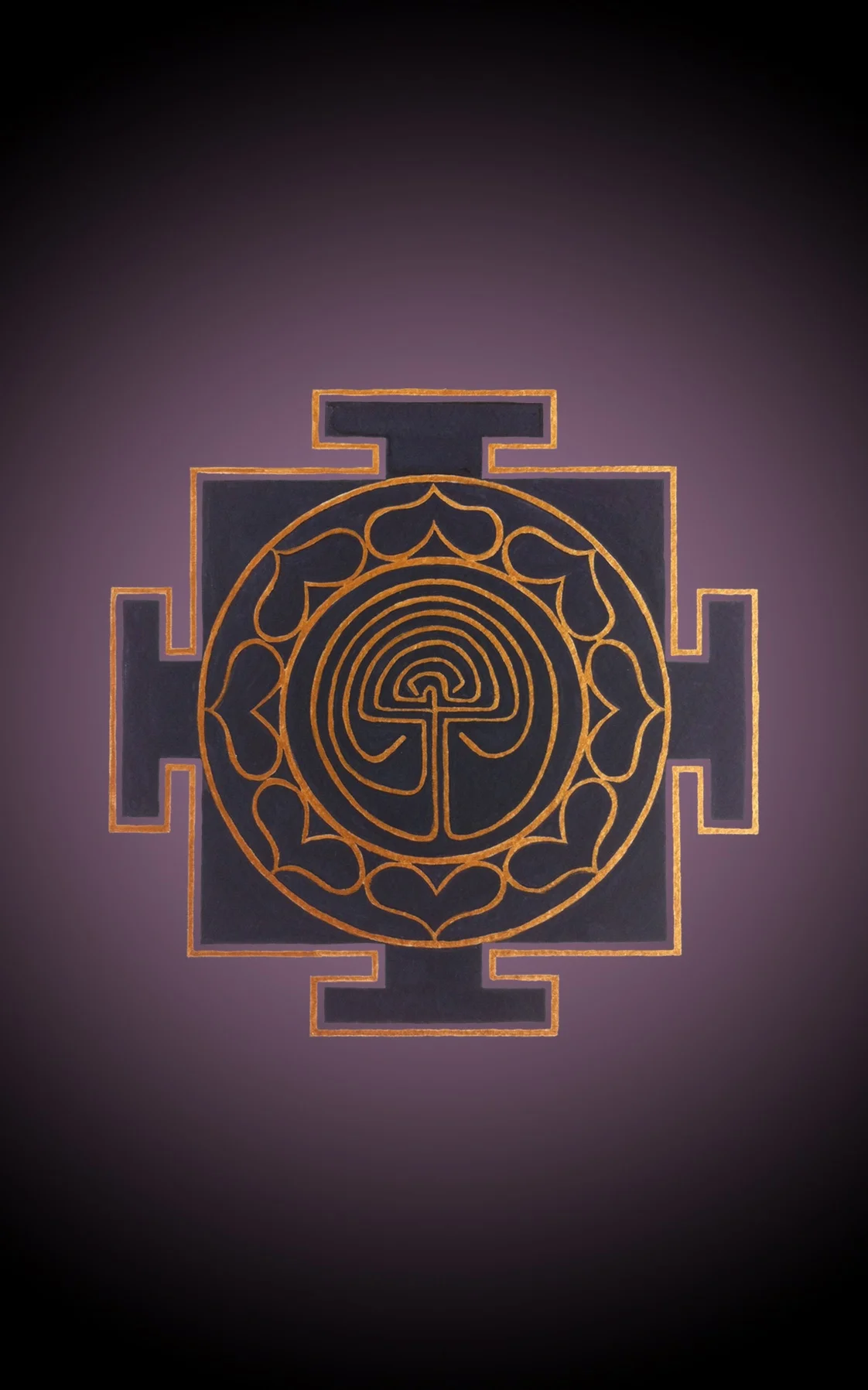
Traditionally this yantra is painted in black and gold.
The password to watch the video is: icaniwillimust108
Day 16 : Sankalpa—Two Ways
“Courage is the most important of all the virtues because without courage, you can't practice any other virtue consistently.” ― Maya Angelou
What makes your resolve, resolution or sankalpa effective is how you interface with it. When the feelings and images of your goal begin to merge, they point to the richness of your intention. As a result, you get a sankalpa that can be clearly stated as a reminder of what your soul truly desires.
There are two ways that a sankalpa can be stated. I have used both methods successfully to fulfill my own intentions.

Method One: An Excited Phone Call
This is the “phone call” or“new school” way, which in my opinion has the capacity to hold more bhavana, the feeling, plus the emotional essence of your desire.
I will use one of my accomplished sankalpas to demonstrate.
One of my most recent goals was to find a home in Minneapolis. As I said in one of the previous posts, it was important for this house to be by the lake, have a fire place and be dog-friendly. To use the first method, imagine getting a phone call from a very good friend of yours who perhaps knows about your goal and is supportive of it.
Friend: “How are you doing?”
Me: ”I love my new home… It’s by the lake, has a fire place and is dog friendly!”
Your answer will contain the emotion [I love] as well as your sankalpa [my new home…by the lake, has a fire place and is dog friendly].
A few pointers on this first method:
- Include the emotion. Here are some examples: I am blessed; I feel fantastic; I have all I need; My energy is back!
- State your sankalpa in the present or past, meaning that it sounds like you have achieved your goal. “I found a new house”; “I cherish the time I spend with my family”; “I completed my final paper, and have graduated!”
- You want to stay away from -ing verbs, for example: I am completing my final paper and will be graduating.
- Let it be in your regular language — using words that you wouldn't actually say can make it inauthentic, and less useful. As a note, if English is not your mother tongue, then use the language you are most confident and comfortable in.
Method Two: Empowerment-Directional-Disciplined
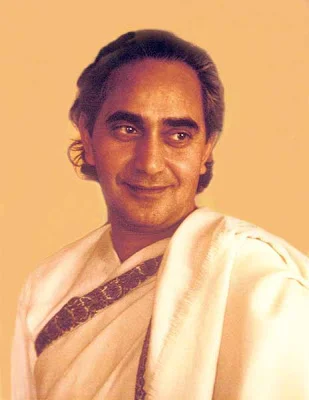
The second is the Swami Rama or “old school” way, which has more of a disciplined-directional attitude. It comes from this quote by Rama: (2003) “The simple method to enlightenment is to first know yourself. Learn to work with yourself; don’t give up in that. Give up on anything else, but don’t give up that goal. Remind yourself, ‘I will continue to work with myself. I can do it, I will do it, and I must do it.’ Remember these three sentences: ‘I can do it. I will do it, and I must do it.’”
I find this way to be very simple and to the point. When I first started to look for my home I used this method: “I can find my home by the lake, I will find my home by the lake, I must find my home by the lake.”
Avoid using the future tense, as there is less shakti or power within the statement.
This method empowers the commitment we have made to ourselves (“ I can”), assures us of the goal (“i will”), and reminds us that failure is not an option (“I must”). (Stryker, 2015)
In the next few days we will be doing two creative projects using both of these methods. You can do them both or choose which one you prefer. Doing both will allow you a greater bond with that goal, as well as help you to finalize the wording if you are still word-smithing your sankalpa.
*Note on Sankalpas*
- A sankalpa states a goal that can be reached in 6 to 18 months.
- Make sure you have clarity around how you know your intention has been fulfilled.
- ,If this is your first time setting a measurable sankalpa, please remember to choose a goal that is on the simpler side.
Here are a few examples from The Four Desires workbook by Rod Stryker
- I'm so excited! I just finished leading my first 8-week life enhancement series.
- My clients are feeling empowered and thriving, and I am feeling fulfilled and living my dharma.
- The home remodel is complete! I have the stability and resources to deepen my practice.
- I can publish my first book by next Fall; I will publish my first book by next Fall; I must publish my first book next Fall.
Day 15: Your Illustrated Desire
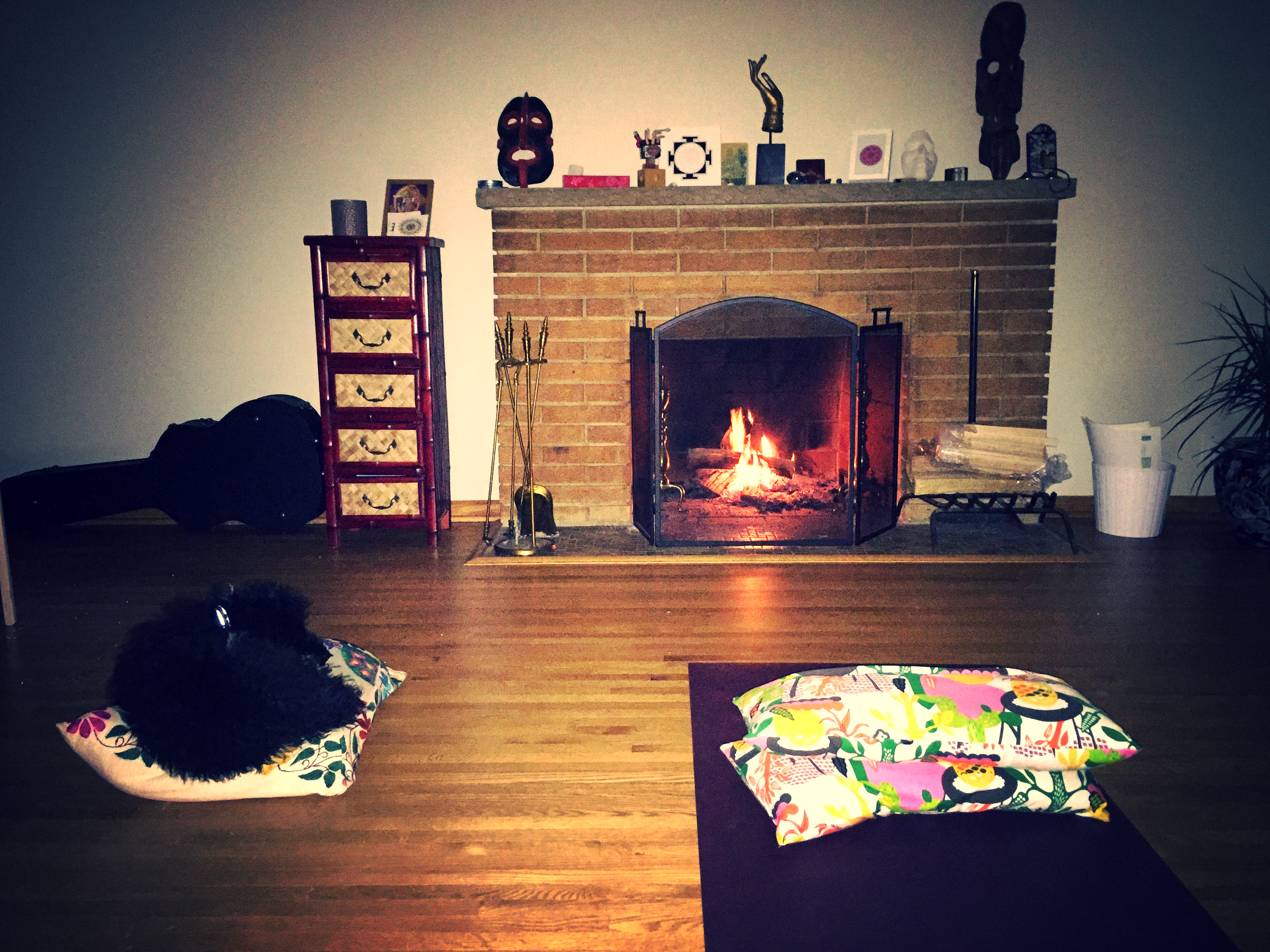
“Without the playing with fantasy no creative work has ever yet come to birth. The debt we owe to the play of imagination is incalculable." — Carl Jung
Now that you have your soul’s desire detailed story, you can illustrate it! Take some time to either make a collage or freehand the story of your desire.
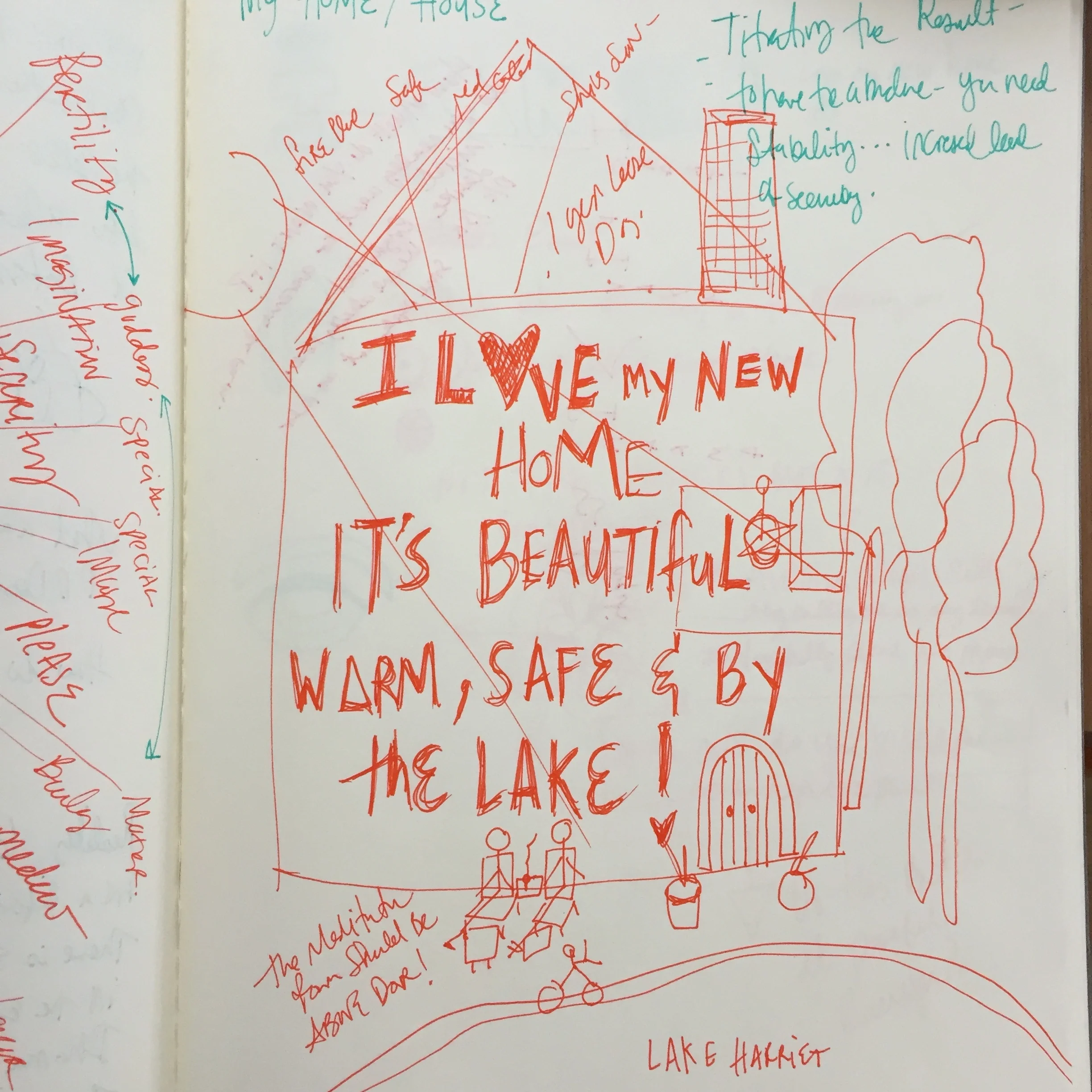
When you search for the images to make your collage, search for those images that resemble the feelings, emotions, and perhaps the details that came from your desire story.
Making a collage or drawing it yourself is helpful because you have the ability to illustrate or find the images, or begin to recognize it as a starting point towards achieving your sankalpa.
The last sankalpa that I achieved was around the Kama desire, and the home I would live in. In my story I saw a home with a fire place and a dog, that was close to the lake. While searching for a place to live in, there was always something missing. I did find one that was close to the lake but it didn’t have a fire place and the owners didn’t accept dogs. It was so beautiful though. It had lots of roomy nooks, and was perfect in so many ways—the best place we had seen! I put in my application that same night and didn’t hear back for days, only to get the disappointing news that another couple was chosen.
We did however find a place with a fire place, close to the lake that was dog-friendly. We weren’t completely sold on the house itself but the warmth of the fire as well as getting a little pooch are all worth it—it’s teaching me so much about love!
Your illustration is there to bring colors to your story, and moving closer to it’s manifestation!

This is Jupiter, he's now 4 months old!
Day 14: Picture your Desire
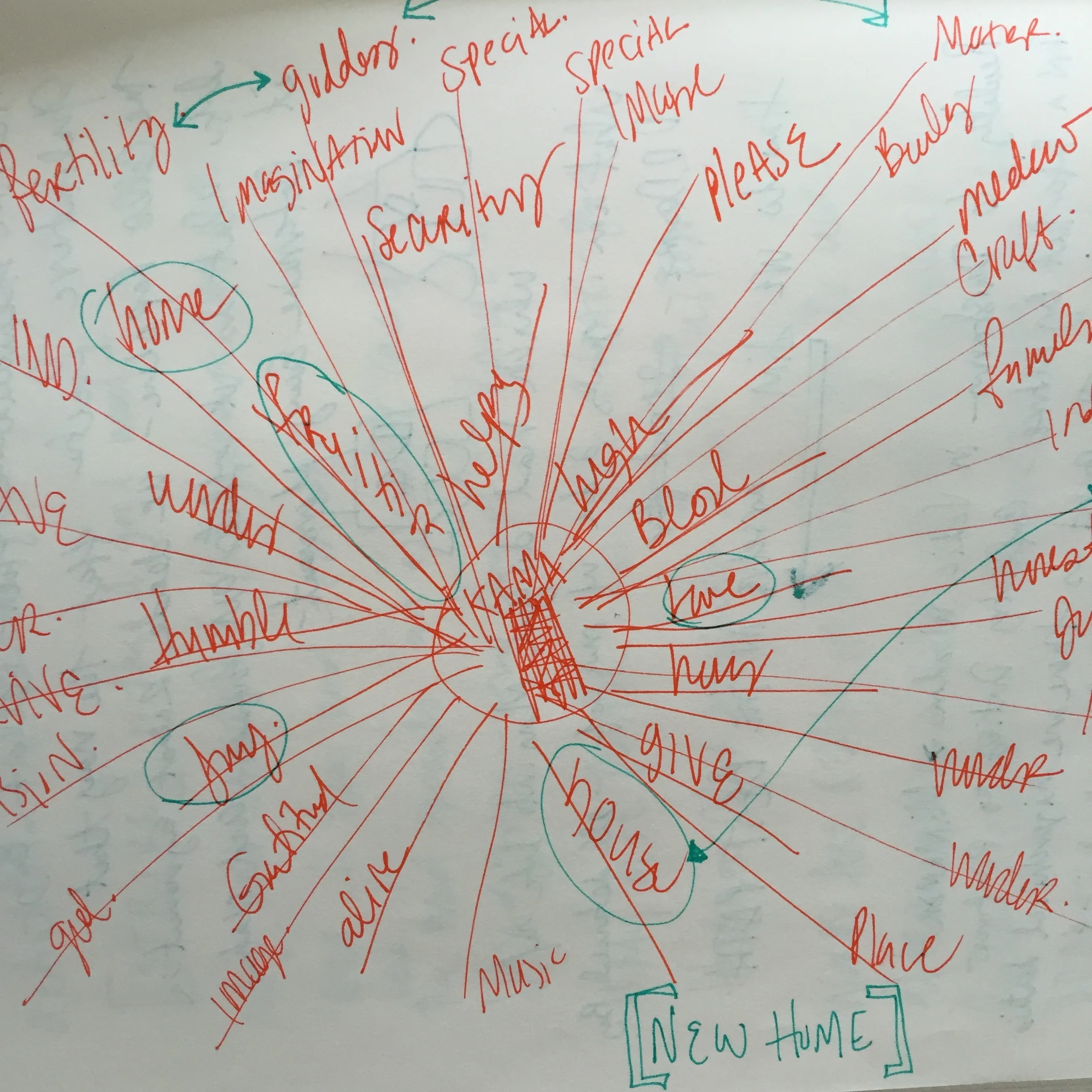
Having a day to digest the desire that has come from your heart, it’s time to look back and see where the treasure is hidden in the mind map.
When I draft a sankalpa, or heart’s intention, I like to look at those words allowing them to speak to me, without judging what they are trying to tell me, similar to listening to the messages of dreams. Dreams do not normally have a structural, or point-A-to-point-B, narrative, yet they can hint to the next place to look for wisdom.
Similarly, this mind map can be used to point you in a direction that you may or may not have been keen on moving towards. On the other hand, sometimes, you know exactly what the words are telling you to seek out and spend time with.
Part 1: Re-reading the Map
To begin, look at your words and answer these questions:
- Are these words pointing to something you wish to attain?
- Do they direct you towards a way of being?
- Can they direct you to an achievable and measurable goal?
These questions start to bring clarity to that goal. Take your time, the soul has different ways of letting us know. Be patient and open to letting something surprise you.
Write your specific goal, as clearly as you can get it. (There will be time for refinement.)
Once your goal is clear, move on to part 2.
Part 2: Your Written Desire
With a clear goal, now let your heart run free to create the story of your desire once it is fulfilled and completed — let it live in your heart and become real.
Give yourself about 10 minutes to write 2-3 paragraphs of what that achievement looks like once fulfilled. Don’t leave out any details, even if they seem silly or unattainable.
Here are some questions to help you begin, or let your pen again be the scribe of your soul’s desire.
- What does it look like to fulfill your desire?
- What are the specific colors, textures, temperatures to your goal?
- Where are you when you achieve your goal?
- Do you have something new in your life, or did you let go of something?
- What are the emotions that come with that achievement?
- How do you know you have attained your goal?
Day 13: Desire
One of the keys to a successful sankalpa or a a resolution without fail, is that it comes from a place of true knowingness, and deep rest. Those desires we think we need are called preya in sanskrit; typically these tend to be impulsive needs. Desires that are inspired by the soul are called shreya; the more we listen to our soul to fulfill those desires, the more wholeness we will experience in our life.
To discern between the needs of the intellect and what our soul wants, we ask the soul—according to the Yoga Vasitha “The self is neither far nor near. It is not inaccessible nor it is in distant places: it is what in oneself appears to be the experience of bliss, and therefore realized in oneself” (Stryker, The Four Desires)
Please read through the next two steps and watch the mind-map making video, before starting meditation and mind mapping.
Part 1. Ananda Kanda Meditation: The Space of Delight
Supplies for meditation:
- a sheet of paper or your journal
- pen or pencil
- 4 desires cards or mandalas
- quiet environment
- comfortable seated posture
To prepare for this meditation, find a quiet place, and make sure you are sitting comfortably. (meditation is approximately 10 minutes.)
In front of you place the cards in no particular order and face down. I prefer to be lead completely by my soul, and rather not have the decision-making come from my intellect, this is why for me face down works best. If I get quiet enough, and I trust my soul, I know that the desire I choose will be the best one at the time.
This method has worked for me, but you can also choose to place the cards face up. Just make sure that they are right in front of you. If for whatever reason, you don’t have your cards at the time you do the meditation, you can write the names of the desires on a paper and flip them over, or as an alternative, you can place your mandalas out in front of you. Whichever method you choose, know that the import part is getting quiet and still enough to listen to the soul.

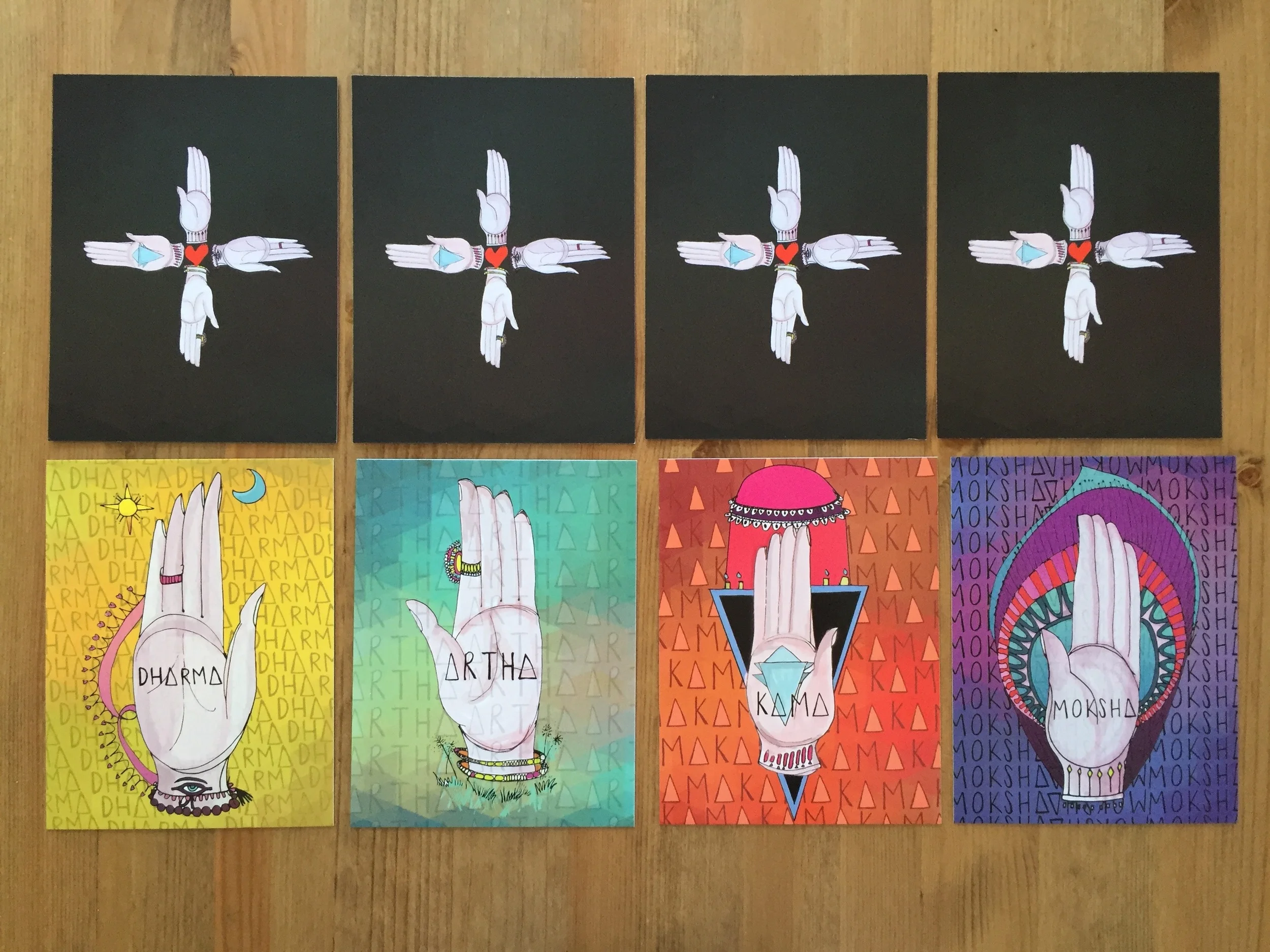
Part 2. Desire
When you are done with your meditation and have a clear desire you will draw a mind map.
- First draw a circle in the middle of your page, inside it write the desire your soul has chosen (Dharma, Artha, Kama or Moksha)
- Then draw a line from the circle outward, and write the first word that you associate to the fulfillment of that desire.
- Draw another line, and another word, until you have 10-15 words branching out from the center desire.
Ideally you are still in that place of true knowingness. Even if a word seems off, or weird, just write it, let your soul be free and your hand be a scribe to what comes to the surface, without any judgement.
Congratulations you are on your way!
Lorem ipsum dolor sit amet, consectetuer adipiscing elit, sed diam nonummy nibh euismod tincidunt ut laoreet dolore magna aliquam erat volutpat.